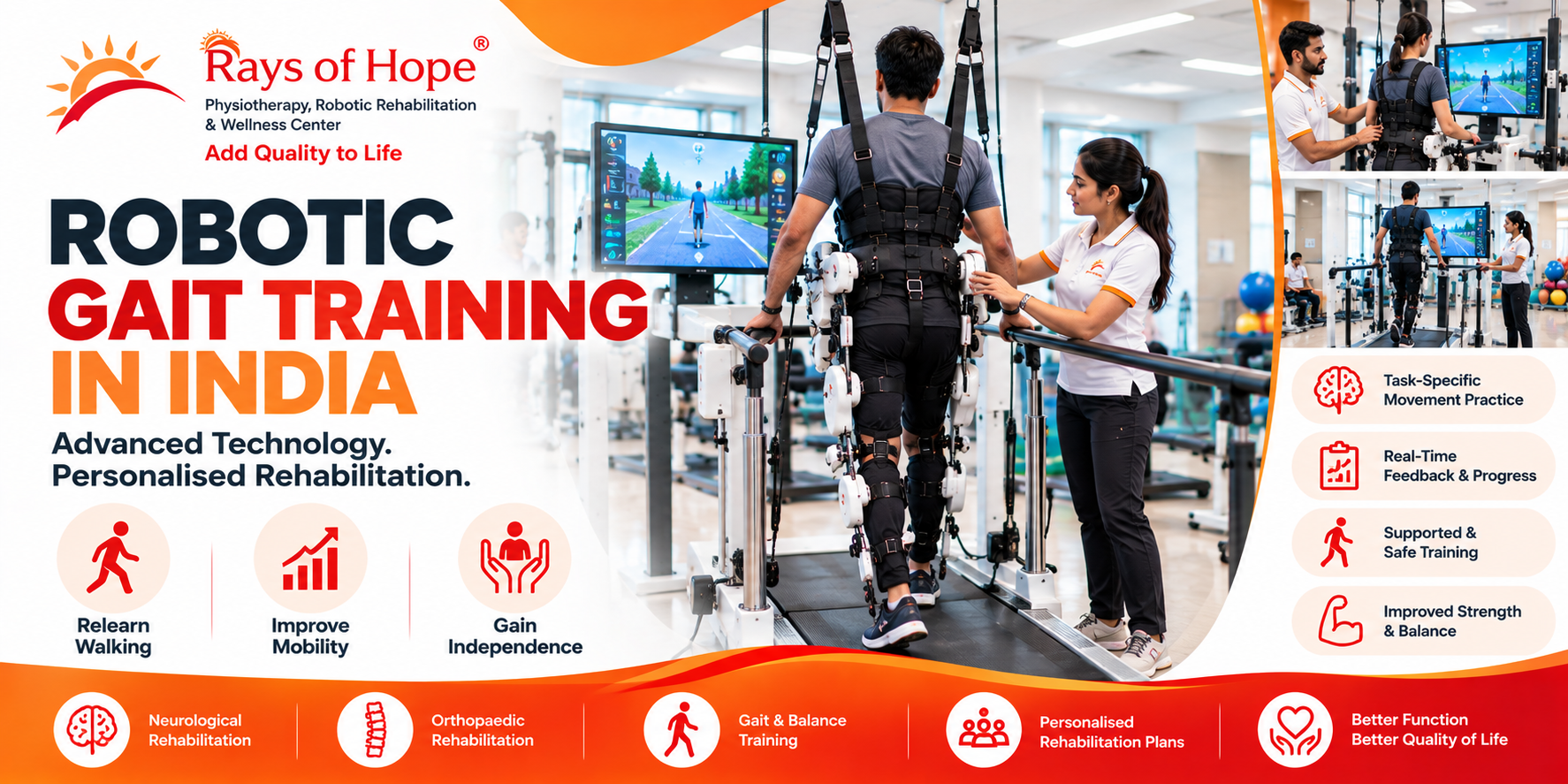
Can Robotic Gait Training Help Improve Walking? Advanced Robotic Rehabilitation in India
Suggested publication date: 1 November 2026
Target audience: Patients and families exploring advanced rehabilitation technology
This topic builds on the advanced robotic rehabilitation article while targeting a more specific search intent: robotic gait training. Your official website lists exoskeleton-assisted gait training and an unweighting robotic gait system among its robotic rehabilitation technologies.
Rays of Hope Rajkot
Complete website-ready blog
Can Robotic Gait Training Help Improve Walking? Advanced Robotic Rehabilitation in India
Walking independently is an important goal for many people undergoing rehabilitation. After a neurological condition, injury or prolonged illness, some individuals experience difficulty standing, taking steps, maintaining balance or walking safely.
Advances in rehabilitation technology have introduced robotic gait training, which uses specialised equipment to assist repetitive walking-related practice under professional supervision.
At Rays of Hope Physiotherapy, Robotic Rehabilitation & Wellness Center, Rajkot, we offer advanced robotic rehabilitation technologies, including exoskeleton-assisted gait training and an unweighting robotic gait system. These technologies may be considered for selected patients following an individual assessment.
In this guide, we answer 10 common questions about robotic gait training, its potential benefits, suitability and role in modern rehabilitation.
Q1. What is robotic gait training?
Robotic gait training is a rehabilitation approach that uses specialised robotic equipment to assist or guide walking-related movements.
Depending on the system, it may support:
Repetitive stepping practice.
Assisted lower-limb movement.
Walking practice with appropriate body-weight support.
Structured movement training.
Progressive practice under therapist supervision.
Some systems use wearable exoskeletons, while others guide the legs through a controlled stepping pattern or reduce the amount of body weight a patient must support.
The type of system used depends on the patient's abilities, safety requirements and rehabilitation goals.
Q2. Who may benefit from robotic gait training?
Robotic gait training may be considered for selected individuals who have difficulty walking because of neurological or other conditions affecting mobility.
Depending on the system and clinical indication, potential candidates may include people undergoing rehabilitation following:
Stroke.
Spinal cord injury.
Traumatic brain injury.
Selected neurological disorders.
Conditions associated with reduced walking ability or lower-limb control.
Eligibility is not determined by diagnosis alone. The rehabilitation team must assess movement, strength, balance, endurance, medical stability, joint limitations and the ability to participate safely.
Robotic gait training is not appropriate for every patient, and conventional gait training may be more suitable in some situations.
Q3. What are the potential benefits of robotic gait training?
When appropriately selected and combined with a suitable rehabilitation programme, robotic gait training may help patients practise walking-related movements more repetitively and systematically.
Potential benefits include:
Repetitive movement practice: Allows structured practice of stepping movements.
Supported training: Some systems provide assistance or body-weight support.
Task-specific rehabilitation: Enables practice focused on walking-related tasks.
Progress monitoring: Certain systems provide data about movement and training performance.
Patient engagement: Interactive systems may make some sessions more engaging.
Research findings vary by patient population, device and treatment protocol. Robotic training should be considered a possible component of rehabilitation—not a guaranteed route to independent walking.
PubMed
+1
Q4. Is robotic gait training useful after a stroke?
Some people experience weakness, impaired balance or difficulty coordinating their legs after a stroke. Walking rehabilitation may form an important part of their recovery programme.
Research reviews suggest that robotic-assisted gait training, when combined with conventional rehabilitation, can improve selected walking and functional outcomes in some people after stroke. However, the extent of benefit varies, and robotic treatment does not replace individualised physiotherapy.
PMC
+1
A rehabilitation programme may include:
Trunk control and sitting balance.
Standing and weight-shifting practice.
Supported stepping or robotic gait training where appropriate.
Conventional walking practice.
Balance and strength exercises.
Functional activities such as transfers and stair training when suitable.
The treatment plan should reflect the patient's current abilities, medical status and personal goals.
Q5. What is the difference between a robotic exoskeleton and an unweighting gait system?
These systems support gait training in different ways.
| Technology | General purpose |
|---|---|
| Robotic exoskeleton | A wearable or body-mounted system that assists selected lower-limb movements or stepping tasks. |
| Unweighting robotic gait system | A system that can reduce the amount of body weight a patient must support while practising walking, depending on its design. |
| Conventional gait training | Therapist-guided walking practice, with or without ordinary mobility aids. |
The systems are not interchangeable. The best choice depends on the patient's needs, the device's intended use and the clinical team's assessment.
Q6. Is robotic gait training better than conventional physiotherapy?
Not necessarily. Robotic gait training can provide useful assistance and repetitive practice in selected circumstances, but conventional physiotherapy remains an essential part of rehabilitation.
A comprehensive programme may combine technology-assisted training with:
Strengthening exercises.
Balance and postural control.
Transfers and sit-to-stand practice.
Overground walking.
Functional mobility training.
Home exercise and caregiver education where appropriate.
The evidence differs by condition and technology. For example, a systematic review of robotic-assisted gait training following spinal cord injury found improvements in some functional outcomes, but results should not be generalised to every patient or device.
PubMed
The objective is to improve meaningful function, not simply to complete more sessions on a machine.
Q7. How is a robotic gait training programme planned?
A structured programme generally involves several steps.
Clinical assessment
The rehabilitation professional assesses walking ability, strength, balance, joint movement, endurance, medical history and safety considerations.
Goal setting
Goals may include improving stepping ability, standing tolerance, walking practice or functional mobility, depending on the patient's condition.
System selection
The team decides whether robotic assistance, body-weight support, conventional gait training or a combination is appropriate.
Supervised training
The patient practises suitable movements under professional supervision, with assistance adjusted according to the system and clinical protocol.
Progress review
Walking ability, movement quality, endurance and relevant functional measures are reassessed to guide the next stage of rehabilitation.
The number and frequency of sessions should be individualised. A fixed package or timeline cannot be recommended for everyone without assessment.
Q8. Can robotic gait training help someone who cannot walk independently?
Possibly, in selected cases. Some robotic systems are designed to support stepping practice for people who need substantial assistance.
However, being unable to walk independently does not automatically mean someone is suitable for a particular robotic device.
The team must consider factors such as:
Medical stability.
Ability to tolerate upright positioning.
Joint range and musculoskeletal limitations.
Skin integrity and pressure-related risks.
Strength, tone and movement control.
Cognitive ability to participate and follow instructions.
Equipment-specific safety requirements.
For some patients, early rehabilitation may need to focus on positioning, transfers, sitting balance or supported standing before walking practice is appropriate.
A clinical assessment is essential before choosing the training method.
Q9. How long does it take to see results from robotic gait training?
There is no universal timeline. Progress depends on the underlying condition, severity of impairment, time since onset, general health, training frequency and the patient's response to treatment.
Progress may be measured through changes in:
Standing tolerance.
Stepping performance.
Walking speed or distance.
Balance and functional mobility.
Assistance required during walking.
Ability to perform relevant daily activities.
Improvements in one measure do not necessarily mean a patient is ready to walk independently. Goals and outcomes should be reviewed regularly by the rehabilitation team.
Q10. Where can I access advanced robotic gait training in India?
Patients should look for a rehabilitation centre that combines suitable technology with qualified professionals, individualised treatment planning and regular assessment of functional progress.
Rays of Hope Physiotherapy, Robotic Rehabilitation & Wellness Center in Rajkot, Gujarat, offers advanced robotic rehabilitation technologies, including exoskeleton-assisted gait training and an unweighting robotic gait system.
Rays of Hope Rajkot
Our approach emphasises selecting the appropriate rehabilitation method according to the patient's condition and goals.
Patients and families are encouraged to ask the rehabilitation team:
Which robotic system may be suitable for my condition?
What goals can we reasonably work towards?
How will progress be measured?
What other physiotherapy will be included?
What precautions or restrictions apply?
Explore robotic rehabilitation at Rays of Hope
Rays of Hope — Physiotherapy, Robotic Rehabilitation & Wellness
Add Quality to Life.

University Road Branch
Near Khodiyar Dairy, Panchayat Chowk, University Road, Rajkot, Gujarat.

Mota Mava Branch
Opp. Sunshine School, Behind Karan Arjun Party Plot, New Ring Road, Rajkot, Gujarat.
Phone: +91 82001 33691
Website: www.raysofhope.co.in
Medical disclaimer: This article is for educational purposes only. Robotic gait training suitability and outcomes vary by patient, diagnosis and device. A professional assessment is required.