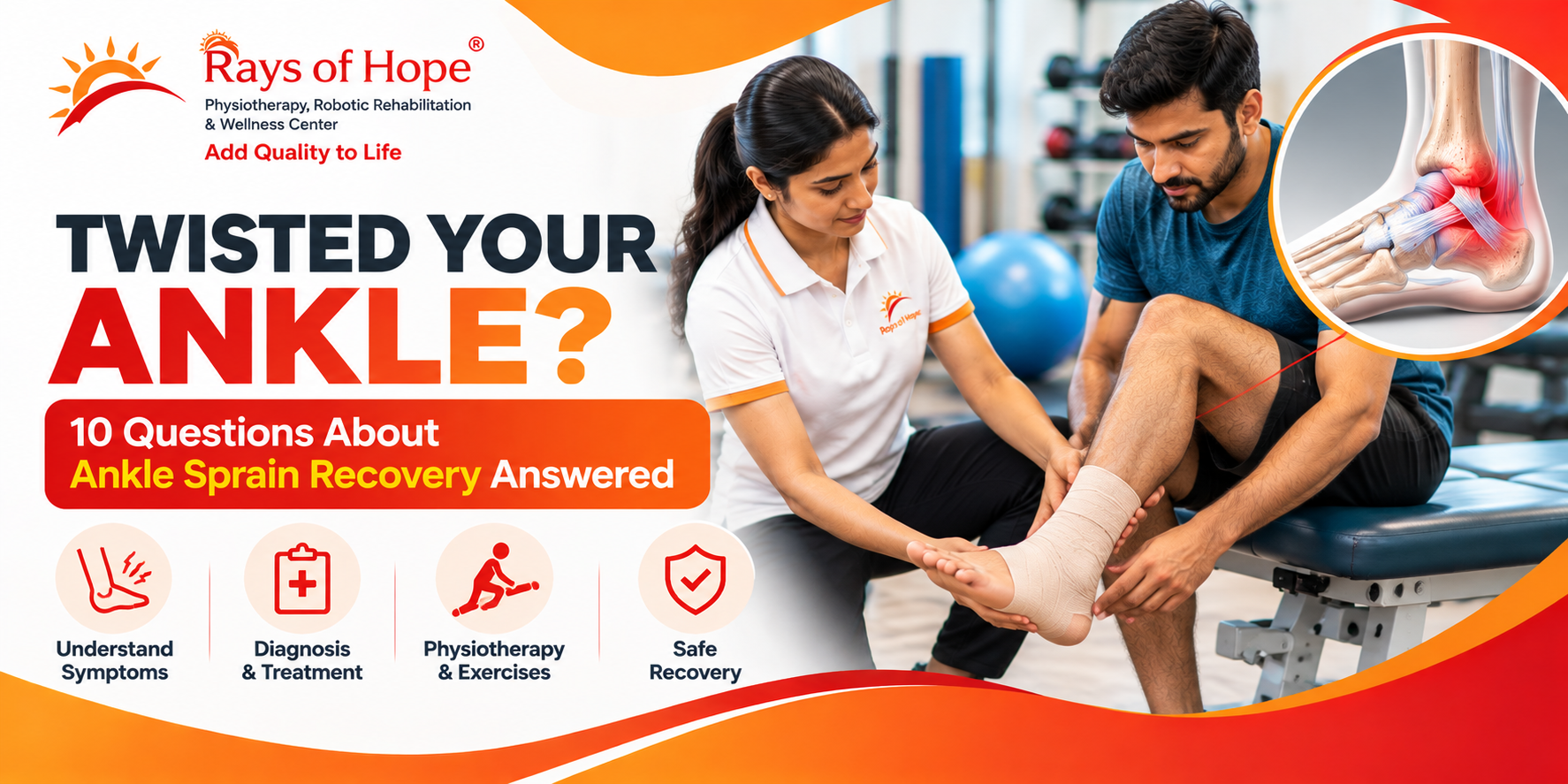
Twisted Your Ankle? How to Reduce Swelling and Recover Safely ?
An ankle sprain can happen while walking on uneven ground, playing sports, dancing, running or stepping awkwardly off a curb. The ankle may swell, become painful and make walking difficult.
Although many ankle sprains recover without surgery, returning to activity too quickly can increase the risk of repeated injury and ongoing ankle instability.
At Rays of Hope Physiotherapy, Robotic Rehabilitation & Wellness Center, Rajkot, rehabilitation focuses on restoring ankle movement, strength, balance and functional confidence according to the severity of the injury.
Here are 10 important questions about ankle sprains and recovery.
Q1. What is an ankle sprain?
An ankle sprain occurs when the ligaments supporting the ankle are stretched or torn. Ligaments connect bones and help stabilise the joint.
The most common type affects the ligaments on the outer side of the ankle, often after the foot rolls inward.
An ankle sprain may be classified as mild, moderate or severe, depending on the extent of ligament injury and the resulting pain, swelling and instability. A fracture or other injury can sometimes produce similar symptoms, so an examination may be necessary.
AAOS
+1
Q2. What are the symptoms of an ankle sprain?
Common symptoms include:
Pain around the ankle, particularly after twisting or rolling the foot.
Swelling around the ankle joint.
Bruising or tenderness.
Difficulty walking or putting weight on the affected foot.
Restricted ankle movement.
A feeling that the ankle is weak or unstable.
Symptoms vary with injury severity. Significant swelling, inability to walk or severe pain should not automatically be assumed to indicate a simple sprain.
Q3. What should I do immediately after twisting my ankle?
During the early phase, protect the ankle and avoid activities that significantly increase pain.
Helpful measures may include:
Protection: Avoid further twisting and use suitable support if advised.
Elevation: Raise the ankle when resting to help manage swelling.
Cold application: Apply a cold pack wrapped in a towel for short periods if it helps relieve pain. Do not apply ice directly to the skin.
Support: A suitable ankle brace or bandage may be recommended after assessment.
Medical assessment: Seek care when the injury is severe or a fracture is possible.
Avoid forcing painful movements or returning immediately to running, jumping or sports.
Current rehabilitation guidance generally supports progressive weight-bearing and movement when appropriate for the injury, rather than prolonged complete rest for every sprain. More severe injuries may need a short period of immobilisation under clinical guidance.
DOI
+1
Q4. How do I know whether I have an ankle sprain or a fracture?
It can be difficult to distinguish a fracture from a severe sprain based on symptoms alone.
A clinician may examine the location of tenderness, swelling, ability to bear weight and the mechanism of injury. X-rays may be needed when the examination indicates a possible fracture.
Seek urgent medical evaluation if:
You cannot bear weight or walk more than a few steps.
There is severe or increasing pain or substantial swelling.
The ankle or foot looks deformed.
The foot becomes numb, cold or unusually pale or blue.
There is an open wound or suspected fracture.
Do not attempt to test the ankle repeatedly by walking on it if doing so causes significant pain.
AAOS
+1
Q5. Can an ankle sprain heal without surgery?
Yes. Most isolated ankle sprains are managed without surgery.
Treatment may include temporary protection, appropriate support, progressive movement, strengthening and balance exercises. Severe ligament injuries still require proper assessment and structured rehabilitation.
Surgery may be considered in selected cases, such as persistent mechanical instability despite appropriate non-surgical treatment or certain associated injuries.
The right treatment depends on the injury, previous ankle sprains, functional demands and examination findings.
AAOS
+1
Q6. How can physiotherapy help an ankle sprain?
Ankle sprain physiotherapy in Rajkot can help address the problems that remain after the initial injury.
A tailored programme may include:
Pain and swelling management: Strategies based on the stage and severity of injury.
Range-of-motion training: Gradually restoring comfortable ankle movement.
Strengthening: Improving the muscles that support ankle and foot control.
Gait retraining: Helping you walk more normally as weight-bearing becomes appropriate.
Balance and proprioception exercises: Improving the body's awareness of ankle position and movement.
Functional training: Preparing for stairs, work, daily activities and sport.
Manual therapy may also be appropriate for selected patients when combined with exercise.
Rehabilitation should progress according to the person's symptoms, examination findings and functional goals.
DOI
+1
Q7. Which exercises are useful after an ankle sprain?
The exercises depend on the injury's severity and the stage of recovery. Common rehabilitation components include:
Gentle ankle movements: Moving the foot up and down within a comfortable, permitted range.
Ankle mobility exercises: Gradually improving movement when pain and swelling allow.
Resistance exercises: Strengthening the ankle muscles as tolerated.
Calf strengthening: Progressing towards heel raises when suitable.
Balance training: Developing stability during standing and controlled weight-bearing.
Functional drills: Later progression to stepping, hopping, landing and sport-specific movements when appropriate.
Do not begin all these exercises immediately after an injury. If you suspect a fracture, cannot bear weight, or have severe swelling, seek assessment before starting an exercise programme.
If exercises increase pain or swelling significantly, reduce the load and consult your treating clinician.
Q8. How long does it take to recover from an ankle sprain?
Recovery varies according to the severity of the injury, associated damage, previous sprains, general health and rehabilitation progress.
Mild sprain: Everyday function may improve over a relatively short period.
Moderate sprain: Recovery may take several weeks, depending on symptoms and stability.
Severe sprain: Recovery may take several months, particularly when substantial ligament damage or associated injuries are present.
These are broad expectations, not guaranteed timelines. Returning to sport often requires more than being able to walk comfortably. Strength, balance, hopping, landing control and confidence should be assessed when relevant.
Do not return to demanding activities solely because the swelling has reduced.
AAOS
+1
Q9. Why does my ankle keep twisting or giving way?
Repeated ankle sprains can occur when the ankle has not fully regained strength, balance, coordination or stability after an earlier injury.
Persistent symptoms may be associated with:
Reduced ankle muscle strength.
Limited ankle movement.
Impaired balance and proprioception.
Incomplete rehabilitation.
Ongoing ligament instability.
Returning to sport before meeting functional recovery goals.
A physiotherapist can assess these factors and develop a programme that addresses the identified deficits. Balance and neuromuscular training, together with appropriate bracing where indicated, can help reduce the risk of recurrent sprains. A brace alone does not replace rehabilitation.
DOI
+1
Q10. Where can I get ankle sprain physiotherapy in Rajkot?
At Rays of Hope Physiotherapy, Robotic Rehabilitation & Wellness Center, Rajkot, the rehabilitation plan can be tailored to your ankle injury, walking ability, work requirements and sporting goals.
Depending on your assessment, treatment may focus on:
Restoring ankle mobility and strength.
Improving walking and balance.
Rebuilding functional stability.
Progressing safely towards exercise and sport.
Reducing the risk of recurrent ankle sprains.
If you have already undergone an X-ray, MRI or orthopaedic consultation, bring the reports to your appointment.
Book a physiotherapy assessment in Rajkot
Rays of Hope — Add Quality to Life

University Road Branch
Near Khodiyar Dairy, Panchayat Chowk, University Road, Rajkot, Gujarat.

Mota Mava Branch
Opp. Sunshine School, Behind Karan Arjun Party Plot, New Ring Road, Rajkot, Gujarat.
Call: +91 82001 33691
Website: www.raysofhope.co.in
Medical disclaimer: This article is for educational purposes and does not replace a clinical examination. Seek appropriate medical care when a fracture or serious injury is suspected.