Your feet are the foundation of your body.
Every time you stand, walk, run, climb stairs or exercise, your feet interact with the ground and influence how forces travel through the ankles, knees, hips and spine.
Sometimes, problems such as heel pain, flat feet, abnormal pressure distribution or altered walking patterns can affect more than just the foot. A detailed foot assessment can help physiotherapists understand these movement and loading patterns.
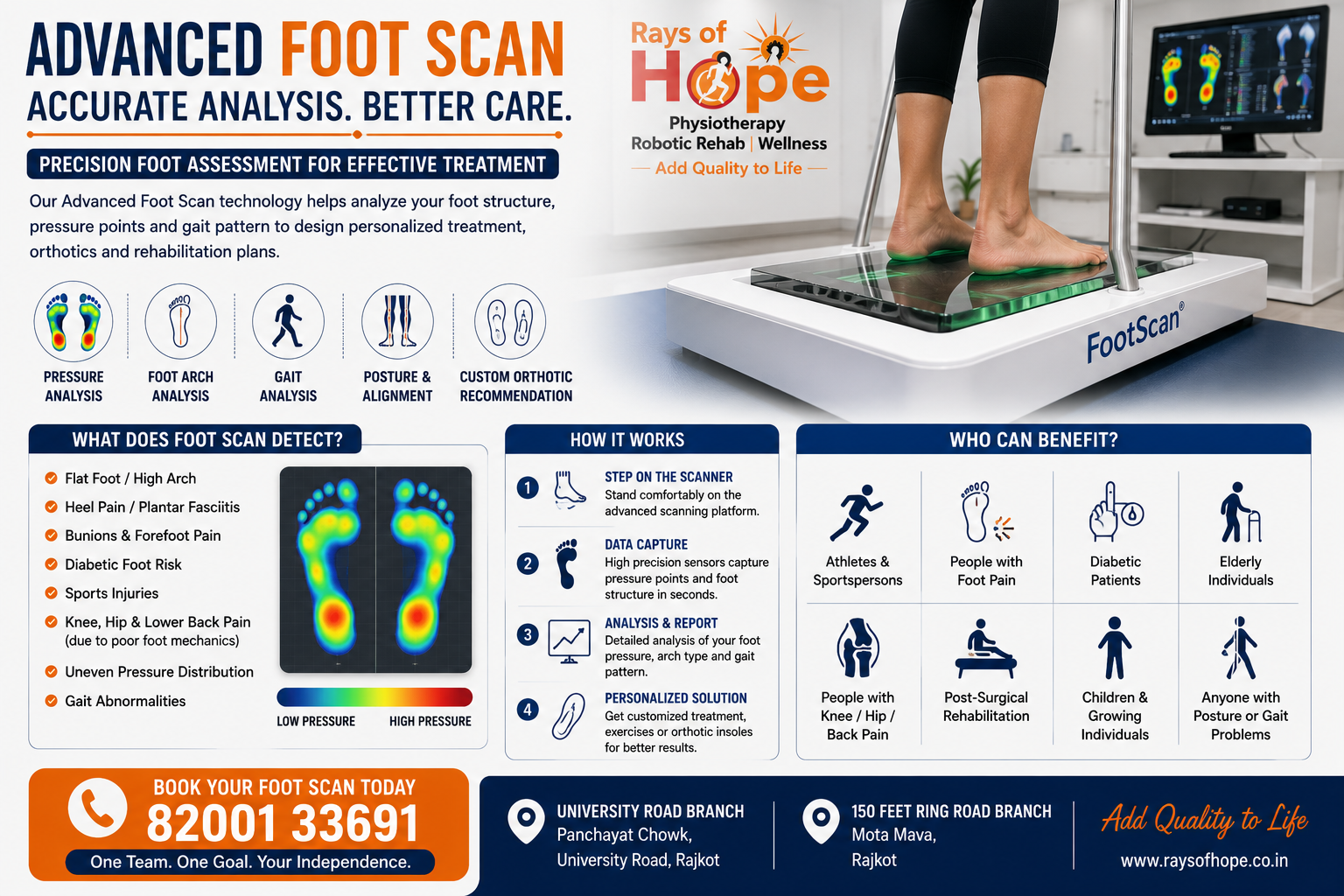
At Rays of Hope Physiotherapy – Robotic Rehab – Wellness, Rajkot, Advanced Foot Scan technology is available to support objective assessment of foot pressure, foot mechanics and gait-related problems as part of a comprehensive physiotherapy and rehabilitation program.
What Is a Foot Scan?
A foot scan is a technology-assisted assessment that can capture information about how the feet interact with the ground.
Depending on the system used, it may provide information about:
- Plantar pressure distribution
- Pressure concentration areas
- Left-right loading differences
- Foot contact pattern
- Arch characteristics
- Static weight distribution
- Dynamic gait pattern
- Movement-related loading
Instead of relying only on visual observation, a computerized foot-pressure assessment can provide objective data that can be discussed alongside the physiotherapist's clinical examination.
In simple words:
Foot Scan = Understanding how your feet bear load and interact with the ground.
Why Is Foot Scanning Important?
A person may experience pain somewhere else in the body while the underlying movement problem involves the lower limb.
For example, altered foot mechanics may be one of several factors associated with:
Foot → Ankle → Knee → Hip → Pelvis → Lower Back
This does not mean that every knee or back problem is caused by the feet.
Rather, foot and gait assessment can help identify whether foot loading or movement patterns are contributing to the individual's functional problem.
What Can a Foot Scan Assess?
1. Plantar Pressure
The scan can show how pressure is distributed underneath the feet.
It can help identify areas experiencing relatively higher or lower pressure during the assessment.
This may be relevant in people with:
- Foot pain
- Heel pain
- Sports-related problems
- Gait abnormalities
- Certain diabetic foot risks
2. Left-Right Weight Distribution
A person may unknowingly place more weight through one foot.
This can occur because of:
- Pain
- Weakness
- Previous injury
- Limited mobility
- Balance problems
- Habitual movement patterns
A computerized assessment can help identify asymmetrical loading that may warrant further clinical evaluation.
3. Foot Arch Assessment
Foot shape and arch characteristics vary considerably between individuals.
A scan can provide additional information about foot contact and loading patterns that may be relevant when assessing:
- Flat feet
- High arches
- Foot discomfort
- Lower-limb movement problems
However, foot shape alone does not determine whether a person has a problem. Symptoms and functional assessment remain important.
4. Gait Analysis
Walking is a complex movement involving the:
Foot + Ankle + Knee + Hip + Pelvis + Trunk
A foot scan can be used as one component of gait assessment to understand how the foot interacts with the ground during walking.
This can be particularly useful in rehabilitation programs involving:
- Stroke
- Neurological conditions
- Sports injuries
- Orthopaedic problems
- Balance disorders
- Walking difficulties
Major Benefits of Foot Scanning
🦶 1. Objective Assessment
One of the biggest advantages is that the assessment can provide measurable information rather than relying entirely on visual observation.
This can help the physiotherapist understand the patient's movement and loading pattern more objectively.
📊 2. Identifying Pressure Patterns
Foot scanning can highlight areas of relatively increased plantar pressure.
This may help guide further clinical assessment and management.
⚖️ 3. Understanding Weight Distribution
Identifying differences between the right and left sides can provide useful information about loading and functional movement.
🚶 4. Supporting Gait Assessment
Foot pressure information can complement a broader gait assessment.
This can be valuable when a patient has:
- Abnormal walking
- Reduced walking confidence
- Uneven weight bearing
- Previous lower-limb injury
- Neurological weakness
🎯 5. Personalized Rehabilitation
Foot-scan findings can be combined with:
- Physiotherapy assessment
- Muscle strength testing
- Range-of-motion assessment
- Balance testing
- Gait analysis
- Functional assessment
This allows the rehabilitation program to be more individualized.
👟 6. Supporting Orthotic Assessment
In selected patients, foot-pressure information may help clinicians evaluate whether footwear or orthotic intervention should be considered.
A foot scan does not automatically mean that a person needs custom orthotics.
The decision should be based on clinical assessment, symptoms, functional requirements and the individual's goals.
Who Can Benefit From a Foot Scan?
Foot scanning may be useful for a wide range of people.
🏃 Athletes & Sportspersons
Useful as part of assessment for:
- Running-related problems
- Repetitive loading
- Lower-limb injuries
- Return-to-sport rehabilitation
- Performance-related movement assessment
🦵 People With Knee Problems
For patients with knee pain, foot and lower-limb assessment can provide additional information about movement and loading.
This may be incorporated into a broader knee rehabilitation program.
🦶 People With Heel Pain
Patients with conditions such as plantar heel pain may benefit from assessment of:
- Pressure distribution
- Foot loading
- Walking pattern
- Footwear
- Lower-limb mechanics
🧠 Neurological Rehabilitation Patients
Patients recovering from:
- Stroke
- Paralysis
- Parkinson's disease
- Spinal cord injury
- Other neurological conditions
may develop altered weight-bearing and gait patterns.
Foot scanning can be used as one component of a comprehensive gait and functional assessment.
👵 Older Adults
Older adults with balance or mobility problems may benefit from objective assessment of foot loading as part of a broader rehabilitation evaluation.
🩺 People With Diabetes
Foot assessment can be particularly important for people with diabetes because abnormal plantar pressure can contribute to areas of increased mechanical loading.
However, a foot scan should not replace routine diabetic foot examination or medical care.
Foot Scan for Sports Rehabilitation
For athletes, the feet absorb and transfer forces repeatedly during:
- Running
- Jumping
- Landing
- Cutting
- Sprinting
A foot scan can provide additional information about how the athlete loads the feet.
This information can be combined with:
Foot Scan + Gait Analysis + Strength Assessment + Functional Testing
to develop a more comprehensive rehabilitation or performance plan.
Foot Scan and Knee Pain
Knee pain is not always a knee-only problem.
The entire lower limb works as a kinetic chain.
A physiotherapist may therefore assess:
- Foot
- Ankle
- Knee
- Hip
- Pelvis
Foot scanning can provide additional information about plantar loading and asymmetry.
But an important point:
A foot scan cannot diagnose the cause of every knee problem.
It should be interpreted together with a proper clinical assessment.
Foot Scan and Back Pain
The relationship between foot mechanics and back pain is complex.
A person's walking pattern involves multiple joints and muscles, and altered lower-limb mechanics may be one of several factors affecting movement.
For people with back pain, foot scanning may therefore be considered when the physiotherapist suspects that lower-limb mechanics are relevant.
It should be treated as an assessment tool—not a stand-alone diagnosis of back pain.
Foot Scan & Custom Orthotics
One of the common reasons people seek computerized foot assessment is to understand whether they might benefit from orthotic support.
Orthotics may be considered in selected situations, but:
Not everyone with flat feet needs orthotics.
Not everyone with high arches needs orthotics.
Not everyone with abnormal pressure needs orthotics.
The decision should consider:
- Symptoms
- Foot function
- Activity level
- Footwear
- Gait
- Lower-limb mechanics
- Clinical diagnosis
- Patient goals
A foot scan can provide useful information, but the clinical interpretation is more important than the scan itself.
What Happens During a Foot Scan at Rays of Hope?
A typical assessment may follow a simple process:
Step 1 — Clinical Assessment
The physiotherapist discusses your symptoms, activity level, medical history and functional concerns.
Step 2 — Foot Scan
The patient stands or walks on the scanning platform according to the assessment protocol.
Step 3 — Data Analysis
The system captures relevant foot-pressure and loading information.
Step 4 — Clinical Interpretation
The physiotherapist interprets the results alongside the physical examination.
Step 5 — Personalized Plan
Depending on the findings, the rehabilitation plan may include:
- Physiotherapy
- Foot and ankle exercises
- Strengthening
- Balance training
- Gait retraining
- Footwear advice
- Orthotic assessment when appropriate
- Sports rehabilitation
Foot Scan Is Not Just for People With Foot Pain
This is an important advantage.
A foot assessment may be relevant even when the patient does not report significant foot pain.
For example:
Athlete
May want to understand lower-limb loading during sports rehabilitation.
Stroke Patient
May demonstrate asymmetrical weight bearing during standing and walking.
Knee Rehabilitation Patient
May require assessment of the entire lower-limb movement chain.
Older Adult
May require balance and gait assessment.
Person With Heel Pain
May need evaluation of pressure distribution and walking mechanics.
Foot Scan + Physiotherapy: A Better Assessment Approach
The strongest approach is not:
Scan → Diagnosis
It is:
Clinical Assessment
↓
Foot Scan
↓
Movement & Gait Assessment
↓
Identify Functional Problems
↓
Personalized Physiotherapy
↓
Reassessment
This ensures technology is used to support clinical decision-making.
Can Foot Scanning Help Prevent Injuries?
Foot scanning may identify certain loading patterns that warrant attention, but it should not be marketed as a guaranteed injury-prediction tool.
Injury risk is influenced by many factors, including:
- Training load
- Strength
- Previous injuries
- Recovery
- Sleep
- Technique
- Fitness
- Mobility
- Equipment
- Individual anatomy
Foot scanning can therefore be one useful component of a broader assessment rather than a prediction system.
Why Choose Rays of Hope for Foot Scan in Rajkot?
At Rays of Hope Physiotherapy – Robotic Rehab – Wellness, Advanced Foot Scan is integrated into a broader rehabilitation environment.
The assessment can be combined with:
🦶 Foot & Ankle Physiotherapy
For mobility, strength and functional problems.
🚶 Gait Training
For walking and functional mobility.
🏃 Sports Rehabilitation
For athletes and active individuals.
🦵 Orthopaedic Rehabilitation
For knee, hip and lower-limb conditions.
🧠 Neuro Rehabilitation
For patients with neurological movement and gait problems.
🤖 Robotic Rehabilitation
For selected patients requiring advanced technology-assisted rehabilitation.
⚖️ Balance Training
For patients with balance and stability problems.
This allows the scan findings to become part of a complete rehabilitation assessment rather than an isolated test.
Who Should Consider a Foot Scan?
You may consider discussing a foot scan with a physiotherapist if you have:
✔ Recurrent foot pain
✔ Heel pain
✔ Flat feet or high arches with symptoms
✔ Recurrent sports injuries
✔ Knee pain with suspected lower-limb mechanics issues
✔ Walking abnormalities
✔ Balance difficulties
✔ Uneven weight bearing
✔ Post-operative lower-limb rehabilitation needs
✔ Difficulty choosing appropriate orthotic support
Frequently Asked Questions
Is a foot scan painful?
No. A standard pressure-based foot scan is generally a non-invasive assessment.
How long does a foot scan take?
The scanning component itself is generally quick, although a proper clinical assessment and interpretation require additional time.
Does everyone need a foot scan?
No. It is an assessment tool and should be used when clinically relevant.
Can a foot scan diagnose flat feet?
It can provide information about foot contact and loading, but diagnosis should involve clinical assessment rather than relying on a scan alone.
Can a foot scan help with knee pain?
It can provide additional information about foot loading and lower-limb mechanics, but knee pain requires a comprehensive assessment.
Can a foot scan help athletes?
Yes, it can be incorporated into sports and gait assessments to understand foot loading and movement patterns.
Does a foot scan mean I need orthotics?
No. Orthotics should only be recommended when clinically appropriate.
Final Takeaway
Your feet are the foundation of every step you take.
A Foot Scan provides valuable information about how you load and use your feet during standing and walking. When combined with professional physiotherapy assessment, gait analysis and functional testing, it can contribute to a more personalized rehabilitation strategy.
At Rays of Hope, our philosophy is simple:
Don't Just Treat the Pain. Understand the Movement.
Foot Scan → Assessment → Personalized Physiotherapy → Better Movement
Advanced Foot Scan Now Available at Rays of Hope, Rajkot
Rays of Hope Physiotherapy – Robotic Rehab – Wellness
📍 University Road Branch – Panchayat Chowk, Rajkot
📍 150 Feet Ring Road Branch – Mota Mava, Rajkot
📞 +91 82001 33691
Add Quality to Life
SEO Details
SEO Title:
Foot Scan in Rajkot | Benefits, Gait Analysis & Physiotherapy | Rays of Hope
Meta Description:
Discover the role and benefits of advanced foot scanning in physiotherapy. Learn how foot pressure, gait and loading analysis can support personalized rehabilitation at Rays of Hope, Rajkot.
Primary Keyword:
Foot Scan in Rajkot
Secondary Keywords:
- Foot Scan Rajkot
- Advanced Foot Scan Rajkot
- Foot Pressure Scan Rajkot
- Gait Analysis Rajkot
- Computerized Foot Scan Rajkot
- Foot Pressure Analysis
- Foot Scan for Knee Pain
- Foot Scan for Heel Pain
- Foot Scan for Sports Injury
- Foot Scan for Flat Feet
- Foot Scan for Orthotics
- Gait Assessment Rajkot
- Physiotherapy Foot Assessment Rajkot
Suggested URL:
/foot-scan-in-rajkot/
Featured Image Alt Text:
Advanced foot scan and gait analysis at Rays of Hope Rajkot