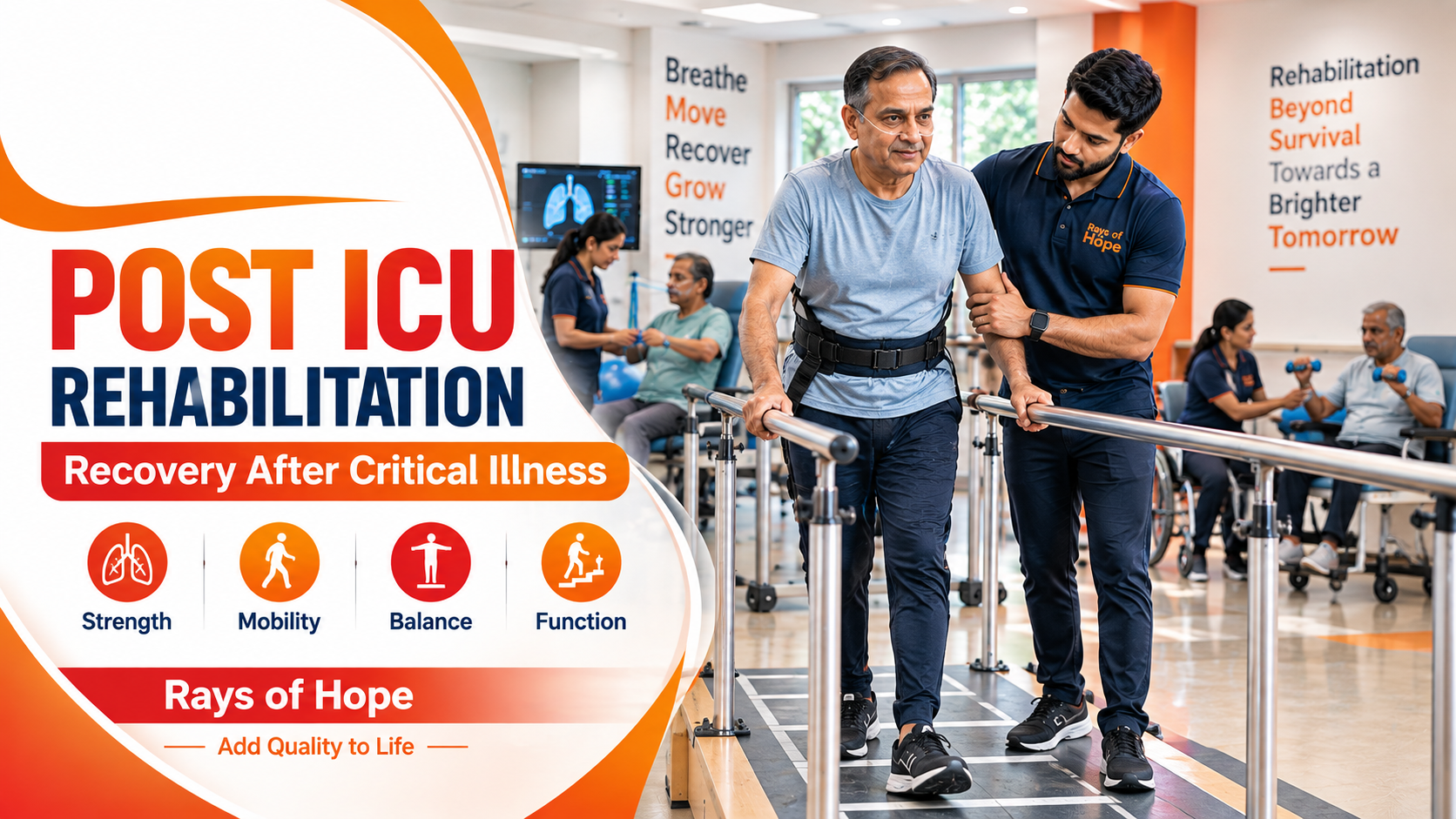
Today's Recommended Blog: Post-ICU Rehabilitation in Rajkot
Why I selected this topic
Your keyword master identifies “post ICU rehabilitation rajkot” as a P1, local-service keyword under the Problem-Solution cluster. It is a strong opportunity because your recent blogs have already covered TKR, post-surgery rehabilitation and Text Neck, while post-ICU rehabilitation targets a different and highly specific patient journey.
Clinically, this is also a valuable topic. Survivors of critical illness can have persistent physical, cognitive and psychological difficulties, collectively described as Post-Intensive Care Syndrome (PICS). Current rehabilitation guidance emphasizes assessment, individualized goals and multidisciplinary rehabilitation. �
Nice +2
Post-ICU Rehabilitation in Rajkot: A Complete Guide to Recovery After Critical Illness
Leaving the ICU is an important milestone.
But for some patients, leaving intensive care does not mean that recovery is complete.
After a prolonged or severe critical illness, a person may experience weakness, reduced endurance, difficulty walking, balance problems, breathing limitations, fatigue, problems with everyday activities, or cognitive and psychological symptoms.
This is why post-ICU rehabilitation can be an important part of the transition from hospital care back to independence.
If you are searching for post ICU rehabilitation in Rajkot, this guide explains what can happen after critical illness, who may need rehabilitation and how physiotherapy and multidisciplinary rehabilitation can support the recovery process.
What Is Post-ICU Rehabilitation?
Post-ICU rehabilitation is structured rehabilitation for people who have experienced significant physical, functional or other rehabilitation needs following critical illness and intensive care.
The needs can be very different from one patient to another.
A patient may need rehabilitation because of:
Prolonged bed rest
Severe muscle weakness
Reduced walking ability
Poor balance
Reduced exercise tolerance
Breathing-related limitations
Difficulty performing daily activities
Neurological complications
Cognitive problems
Psychological difficulties
The Intensive Care Society's PICUPS framework is designed to help identify problems requiring further assessment and guide rehabilitation as patients transition from critical care toward community-based recovery. �
ICS
What Is Post-Intensive Care Syndrome?
Some ICU survivors develop a combination of new or worsening problems involving:
Physical Health
Such as:
Muscle weakness
Reduced mobility
Fatigue
Reduced exercise capacity
Difficulty walking
Cognitive Health
Some patients may experience problems involving:
Attention
Memory
Concentration
Mental processing
Psychological Health
Some ICU survivors may experience:
Anxiety
Depression
Sleep problems
Distressing memories
Other psychological symptoms
This group of problems is commonly referred to as Post-Intensive Care Syndrome (PICS).
A systematic review published in 2024 found that PICS can affect physical function, cognitive function and mental health, with mobility, personal care, usual activities and pain/discomfort among commonly affected quality-of-life domains. �
PubMed
Why Can Patients Become Weak After ICU?
Critical illness can place substantial stress on the body.
During a prolonged hospital or ICU stay, patients may experience:
Prolonged inactivity
Bed rest
Reduced nutritional intake
Severe systemic illness
Mechanical ventilation
Sedation
Muscle deconditioning
Reduced physical activity
As a result, even a person who was independently mobile before becoming critically ill may require assistance after discharge.
Walking 100 metres may suddenly feel like a major achievement.
That is where structured rehabilitation becomes important.
Who May Need Post-ICU Rehabilitation?
Not every person who spends time in an ICU will need a formal rehabilitation program.
Assessment is particularly important for people who have persistent functional limitations after severe illness.
Potential candidates may include patients who have:
Spent a prolonged period in ICU
Required mechanical ventilation
Experienced severe infection or sepsis
Had prolonged bed rest
Developed significant muscle weakness
Difficulty walking after discharge
Difficulty performing daily activities
Reduced exercise tolerance
Balance problems
Persistent fatigue
Neurological complications
Difficulty returning to their previous level of independence
The need for rehabilitation should be determined through individual clinical assessment.
What Does Post-ICU Physiotherapy Include?
1. Functional Assessment
The first step is understanding what the patient can currently do.
Assessment may include:
Bed mobility
Sitting balance
Standing ability
Transfers
Walking
Balance
Muscle strength
Range of movement
Exercise tolerance
Functional independence
The rehabilitation goals should then be based on the patient's current abilities and priorities.
NICE guidance recommends comprehensive assessment for patients at risk of critical-illness-related morbidity and individualized rehabilitation goals. �
Nice
2. Mobility Training
For a severely deconditioned patient, rehabilitation may begin with very basic movements.
The progression might look like:
Bed Mobility
↓
Sitting
↓
Standing
↓
Weight Transfer
↓
Supported Walking
↓
Independent Walking
↓
Community Mobility
The actual progression varies considerably between patients.
3. Strength Recovery
Muscle weakness is one of the major functional challenges following prolonged critical illness.
A rehabilitation program may progressively target:
Lower-limb muscles
Upper-limb muscles
Trunk muscles
Core stability
Postural muscles
Exercises can be modified according to the patient's fatigue, medical status and functional goals.
4. Balance Rehabilitation
Patients may feel unsteady after hospitalization.
Balance rehabilitation may include:
Sitting balance
Standing balance
Weight shifting
Supported standing
Step training
Walking practice
Functional reaching
Turning and direction changes
Safety and supervision are particularly important for patients with significant weakness or fall risk.
5. Gait & Walking Rehabilitation
One of the most important goals for many ICU survivors is simply:
“I want to walk independently again.”
Gait rehabilitation may focus on:
Walking with appropriate assistance
Weight bearing
Step pattern
Balance
Walking endurance
Walking speed
Appropriate walking aids
For selected patients, technology-assisted gait rehabilitation may also be considered.
6. Respiratory & Exercise Rehabilitation
Some ICU survivors have reduced exercise tolerance or respiratory limitations.
Depending on the patient's medical condition, rehabilitation may include:
Breathing exercises
Positioning
Mobilization
Graded activity
Exercise tolerance training
Functional endurance training
This should be coordinated with the patient's medical condition and respiratory status.
7. Functional Independence Training
The ultimate objective isn't simply to increase muscle strength.
It is to help the patient return to daily life.
Functional rehabilitation may involve:
Bed-to-chair transfers
Toilet transfers
Dressing
Bathing-related mobility
Standing from a chair
Walking around the home
Stair training
Household mobility
Independence is a rehabilitation outcome.
How Long Does Post-ICU Rehabilitation Take?
There is no universal recovery timeline.
Recovery depends on:
Severity of the original illness
Length of ICU stay
Pre-illness fitness
Age
Muscle weakness
Neurological complications
Respiratory status
Nutritional status
Other medical conditions
Functional goals
Some people improve substantially over a relatively short period.
Others require rehabilitation for months.
Recovery should be guided by progress—not by an arbitrary deadline.
NICE recommends reassessing people with rehabilitation needs after critical care and referring them to appropriate rehabilitation or specialist services when recovery is slower than expected or new problems emerge. �
Nice
Can Robotic Rehabilitation Be Used After ICU?
Potentially, in selected patients.
Once a patient is medically stable and able to participate safely, technology-assisted rehabilitation may complement conventional physiotherapy.
Depending on the patient's functional level, rehabilitation technology can include:
Active-passive training
Gait training
Balance training
Robotic-assisted movement
Functional electrical stimulation
Virtual reality rehabilitation
At Rays of Hope, the rehabilitation program currently includes Active Passive Training, Robotic FES, Robotic Rehabilitation and Virtual Reality Training among its available services. �
Rays of Hope +2
However:
A robot does not determine whether a patient is ready for rehabilitation.
Clinical assessment comes first.
Post-ICU Rehabilitation Is Not Just Physiotherapy
Recovery after critical illness can involve multiple domains.
Depending on the patient's needs, rehabilitation may involve:
Physiotherapy
For:
Strength
Mobility
Balance
Walking
Exercise capacity
Occupational Therapy
For:
Activities of daily living
Self-care
Functional independence
Fine motor activities
Rays of Hope currently describes occupational therapy with a focus on functional independence, daily living skills and physical/cognitive rehabilitation. �
Rays of Hope
Nutrition Support
Nutrition may be an important component of recovery, particularly in patients with significant deconditioning.
Speech & Swallowing Rehabilitation
Some patients may require assessment or rehabilitation for communication or swallowing difficulties.
Psychological Support
Persistent anxiety, depression or other psychological symptoms may require appropriate professional assessment.
This multidisciplinary approach is consistent with modern approaches to post-critical-illness rehabilitation. A multidisciplinary guideline on PICS rehabilitation recommends interventions including early mobilization, motor training and nutrition/dysphagia management. �
PubMed
When Should You Start Rehabilitation?
There is no single answer for every patient.
During critical illness, rehabilitation may begin as early as clinically possible for patients who are appropriate candidates.
NICE guidance recommends early assessment, identification of rehabilitation needs, individualized goals and structured rehabilitation for patients at risk. �
Nice
After hospital discharge, the timing and intensity of outpatient rehabilitation depend on:
Medical stability
Surgical status
Respiratory condition
Neurological status
Strength
Functional ability
Doctor's recommendations
Medical clearance and clinical assessment should guide progression.
Signs That a Patient May Need Post-ICU Rehabilitation
Consider a rehabilitation assessment if the patient has difficulty:
Getting out of bed
Standing independently
Walking
Climbing stairs
Bathing or dressing
Performing household activities
Maintaining balance
Walking for more than a short distance
Returning to previous activity levels
Persistent fatigue or cognitive and psychological symptoms may also warrant appropriate medical assessment.
Post-ICU Rehabilitation at Home
Some patients may initially find it difficult to travel to a rehabilitation centre.
Home rehabilitation can be useful for selected patients who are:
Bedridden
Elderly
Severely deconditioned
Mobility-limited
Recovering from serious illness
Rays of Hope currently offers home rehabilitation, including post-surgical and neurological rehabilitation, with individualized treatment plans and caregiver/home-exercise guidance. �
Rays of Hope
Post-ICU Rehabilitation at Rays of Hope, Rajkot
At Rays of Hope Physiotherapy, Robotic Rehabilitation & Wellness Center, rehabilitation programs are designed around the patient's functional needs.
The centre currently describes:
Neurological rehabilitation
Orthopedic rehabilitation
Functional training
Balance training
Gait training
Occupational therapy
Robotic rehabilitation
Active-passive training
Virtual reality rehabilitation
Home rehabilitation
Multidisciplinary rehabilitation
�
Rays of Hope +1
For a patient recovering after critical illness, the rehabilitation pathway can be built around:
ASSESS
Understand the current physical and functional status.
ACTIVATE
Begin safe movement according to medical status.
STRENGTHEN
Progressively rebuild physical capacity.
MOBILIZE
Improve transfers, standing and walking.
FUNCTION
Train meaningful daily activities.
PROGRESS
Monitor function and adjust the rehabilitation program.
What Should Family Members Do?
Family involvement can be extremely important.
Families can help by:
Encouraging appropriate activity
Following the prescribed rehabilitation plan
Helping with safe home mobility
Supporting nutrition recommendations
Monitoring fatigue
Helping maintain routines
Communicating changes to the rehabilitation/medical team
But caregivers should avoid forcing exercises or mobility beyond the patient's prescribed limits.
When Should You Seek Medical Review?
Post-ICU rehabilitation should not replace medical evaluation.
Seek appropriate medical attention if the patient develops:
New or worsening breathlessness
Chest pain
Fainting
Sudden neurological symptoms
New severe weakness
Sudden confusion
Significant deterioration in functional status
Fever or suspected infection
Other concerning symptoms
Emergency symptoms require urgent medical care rather than routine physiotherapy.
Post-ICU Rehabilitation in Rajkot
If you or a family member has recently recovered from a serious illness and is struggling with weakness, walking, balance, endurance or daily activities, a rehabilitation assessment can help identify the current functional limitations and appropriate next steps.
Rays of Hope Physiotherapy, Robotic Rehabilitation & Wellness Center
University Road Branch
Near Khodiyar Dairy, Panchayat Chowk, University Road, Rajkot
Mota Mava Branch
Opp. Sunshine School, Behind Karan Arjun Party Plot, New Ring Road, Rajkot
Appointment: +91 82001 33691
Website: www.raysofhope.co.in�
Rays of Hope
Physiotherapy • Robotic Rehabilitation • Wellness
Add Quality to Life
Final Takeaway
Surviving critical illness is a major achievement.
But for some patients, the road back to normal life continues after leaving the ICU.
Post-ICU rehabilitation focuses on more than muscle strength.
It can address:
Mobility → Strength → Balance → Endurance → Function → Independence
The right rehabilitation program should be individualized, medically appropriate and progressively adjusted according to the patient's response.
From surviving critical illness to rebuilding independence — rehabilitation is part of the journey.
SEO PACKAGE
SEO Title:
Post ICU Rehabilitation in Rajkot | Physiotherapy After ICUl
Meta Description:
Learn about post ICU rehabilitation in Rajkot, including weakness, walking, balance, strength, endurance and multidisciplinary recovery after critical illness.
Primary Keyword:
post ICU rehabilitation rajkot
Secondary Keywords:
post ICU physiotherapy Rajkot
post intensive care rehabilitation Rajkot
ICU recovery physiotherapy Rajkot
rehabilitation after ICU
physiotherapy after ICU
critical illness rehabilitation Rajkot
post ICU weakness rehabilitation
ICU survivor rehabilitation
post ICU walking rehabilitation
post ICU muscle weakness
post intensive care syndrome rehabilitation
Suggested URL:
/post-icu-rehabilitation-rajkot/