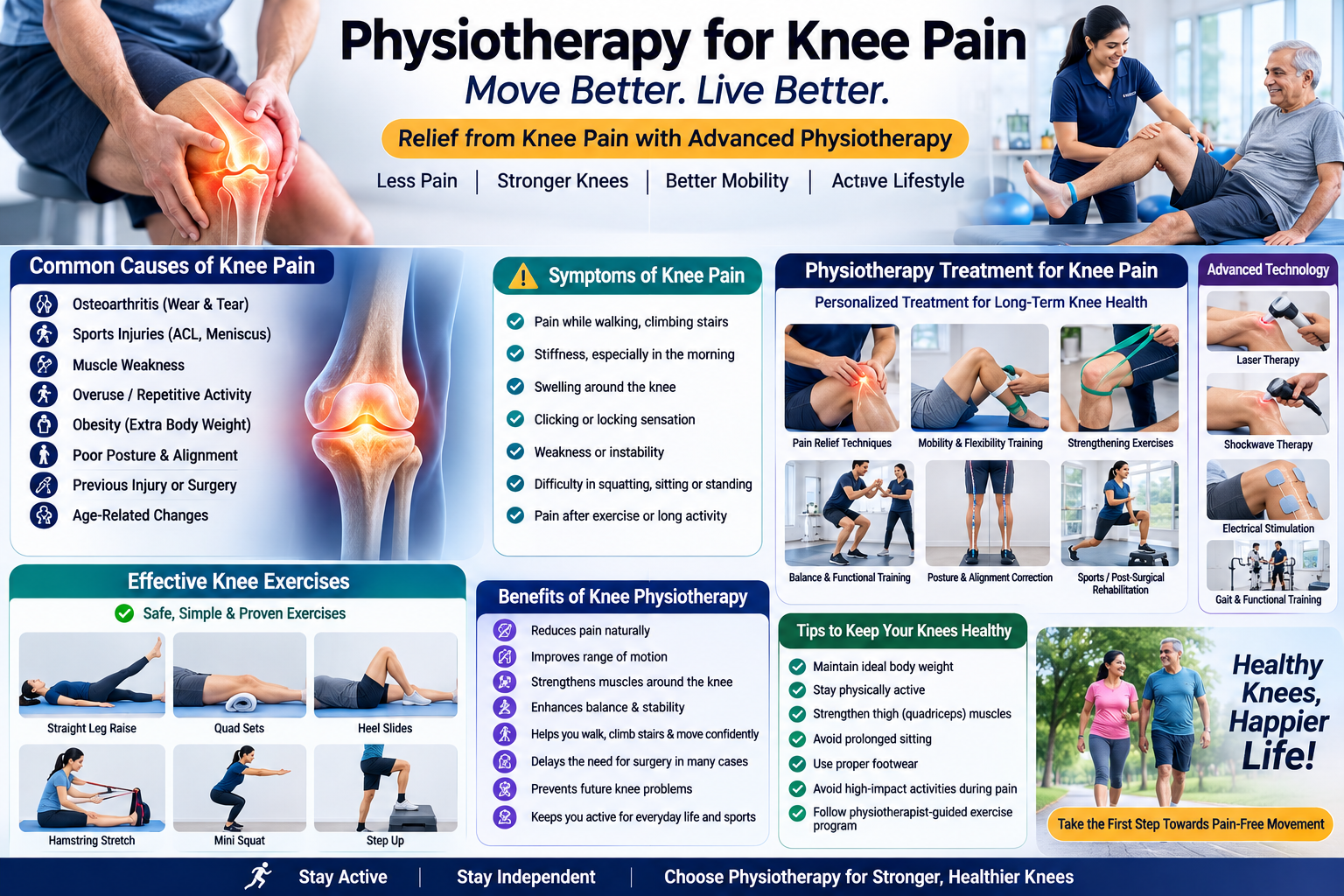
Physiotherapy for Knee Pain in Rajkot: Causes, Treatment, Exercises & Complete Recovery Guide
Knee pain can make simple activities such as walking, climbing stairs, sitting down, standing up, squatting, exercising or playing sports surprisingly difficult.
For some people, knee pain begins after an injury. For others, it develops gradually because of osteoarthritis, muscle weakness, altered movement patterns, previous surgery or increasing physical load.
Physiotherapy can play an important role in restoring knee strength, mobility, balance and functional independence.
At Rays of Hope Physiotherapy, Robotic Rehabilitation & Wellness Center, Rajkot, knee rehabilitation is based on clinical assessment, individualized exercise, functional training, education and appropriate use of advanced rehabilitation technology.
This guide explains the common causes of knee pain, when physiotherapy may help, exercises commonly used in rehabilitation, recovery after surgery and sports injuries, and when medical assessment is necessary.
What Is Knee Pain?
Knee pain is discomfort around the knee joint that may occur during movement, weight-bearing or sometimes even at rest.
It can be felt:
At the front of the knee
Behind the knee
On the inner side
On the outer side
Around the kneecap
Deep inside the joint
Symptoms can include:
Pain
Swelling
Stiffness
Reduced range of motion
Clicking
Difficulty bending or straightening
Feeling of instability
Difficulty walking
Difficulty climbing stairs
Difficulty squatting
Reduced exercise tolerance
The cause of knee pain determines the appropriate rehabilitation approach.
Common Causes of Knee Pain
1. Knee Osteoarthritis
Osteoarthritis is one of the most common causes of persistent knee pain, particularly with increasing age.
It can cause:
Pain during walking
Morning or activity-related stiffness
Swelling
Reduced knee movement
Muscle weakness
Difficulty climbing stairs
Reduced walking endurance
The knee is the most frequently affected joint in osteoarthritis. WHO reports that exercise and maintaining a healthy weight can help reduce symptoms and support function.
Importantly, osteoarthritis is not simply a problem of "wear and tear." It involves the whole joint and surrounding tissues.
2. ACL and Other Ligament Injuries
Sports and traumatic injuries can damage the:
ACL
PCL
MCL
LCL
These injuries may cause:
Swelling
Pain
Instability
Difficulty running
Difficulty changing direction
Reduced confidence in the knee
Rehabilitation is particularly important following ligament injuries and surgery.
3. Meniscus Injury
The meniscus helps distribute load within the knee.
A meniscus injury may cause:
Joint-line pain
Swelling
Clicking
Difficulty squatting
Locking or catching sensations
Management depends on the type and severity of the injury and whether there are mechanical symptoms requiring specialist assessment.
4. Patellofemoral Pain
Pain around or behind the kneecap is often associated with activities such as:
Running
Squatting
Stair climbing
Jumping
Prolonged sitting
Physiotherapy may focus on improving lower-limb strength, movement control, activity management and gradual return to loading.
5. Tendon Problems
Knee pain can also arise from tendons, including:
Patellar tendon
Quadriceps tendon
These conditions can occur with repetitive loading, jumping and sports activities.
Treatment usually involves progressive loading and rehabilitation, rather than simply resting the knee indefinitely.
6. Muscle Weakness
Weakness around the:
Quadriceps
Hamstrings
Gluteal muscles
Calf
can affect lower-limb function.
A physiotherapist can assess whether strength deficits are contributing to the patient's functional limitations.
7. Previous Injury or Surgery
A previous fracture, ligament injury, meniscus injury or knee surgery can sometimes lead to persistent weakness, stiffness or altered movement.
A structured rehabilitation program can help restore function.
8. Increased Body Weight and Physical Load
Body weight is one of several factors associated with knee osteoarthritis.
However, weight should be discussed in a supportive, individualized manner rather than being treated as the only explanation for knee pain.
WHO identifies overweight/obesity as a risk factor for knee and hip osteoarthritis and recommends healthy lifestyle strategies as part of management.
Who Can Benefit From Knee Physiotherapy?
Physiotherapy may be appropriate for:
Older adults with knee osteoarthritis
Athletes
Runners
Gym enthusiasts
People recovering from knee surgery
People with ligament injuries
People with meniscus injuries
People with patellofemoral pain
People with muscle weakness
People with chronic knee pain
People experiencing reduced mobility
The treatment plan should always be based on the individual's diagnosis, symptoms and functional goals.
How Does a Physiotherapist Assess Knee Pain?
A detailed assessment is more important than simply treating the location of pain.
A physiotherapist may evaluate:
Pain
Location
Severity
Duration
Aggravating factors
Relieving factors
Range of Motion
The physiotherapist assesses how far the knee can comfortably:
Bend
Straighten
Hip and ankle mobility may also be assessed because the lower limb functions as a kinetic chain.
Muscle Strength
Assessment may include:
Quadriceps
Hamstrings
Gluteals
Calf muscles
Balance
Particularly important for:
Older adults
Post-operative patients
Athletes
Patients with instability
Walking Pattern
The therapist may assess:
Walking speed
Step length
Knee control
Alignment
Symmetry
Functional Movement
Assessment may include:
Sit-to-stand
Squatting
Step-up
Step-down
Lunging
Stair climbing
Patient Goals
Treatment should also consider what the patient actually wants to return to:
Walking?
Climbing stairs?
Returning to the gym?
Running?
Playing sport?
Returning to work?
These goals influence rehabilitation progression.
Physiotherapy Treatment for Knee Pain
There is no single treatment that works for every knee condition.
A personalized program may include several components.
1. Therapeutic Exercise
Exercise is a major component of knee rehabilitation.
Depending on the condition, exercises may target:
Quadriceps strength
Hamstring strength
Hip strength
Calf strength
Mobility
Balance
Coordination
Endurance
Functional movement
WHO's rehabilitation resources for osteoarthritis include exercise training, lifestyle modification and self-management as important rehabilitation components.
2. Quadriceps Strengthening
The quadriceps are important for:
Walking
Standing
Stair climbing
Squatting
Knee control
Exercises may include:
Quad Sets
Isometric contraction of the quadriceps while the knee is supported.
Straight Leg Raise
Used when the patient can perform the movement safely without significant lag.
Sit-to-Stand
A functional strengthening exercise that can be progressed according to ability.
3. Hip & Gluteal Strengthening
The hip muscles contribute to lower-limb control.
Exercises may include:
Bridges
Side-lying hip abduction
Resistance-band exercises
Step-ups
Functional squats
The exact exercise selection depends on the patient's condition.
4. Mobility Exercises
Depending on the presentation, treatment may include mobility work for:
Knee
Hip
Ankle
Improving movement can help patients perform functional activities more comfortably.
5. Balance & Proprioception Training
Balance rehabilitation may include:
Weight shifting
Single-leg balance
Step training
Dynamic balance
Functional reaching
For older adults, balance training can also be relevant to reducing fall risk.
6. Gait Training
Some patients develop an altered walking pattern because of pain, weakness or previous injury.
Gait training can focus on:
Step length
Weight transfer
Knee control
Walking speed
Confidence
Assistive device use when required
7. Manual Therapy
Manual techniques may be used selectively to address pain, stiffness or movement limitations.
They may include:
Joint mobilization
Soft-tissue techniques
Movement-assisted techniques
Manual therapy should generally complement active rehabilitation rather than replace strengthening and functional exercise.
8. Functional Training
The ultimate objective is not simply stronger muscles.
The patient needs to use those muscles during real activities.
Functional rehabilitation may include:
Sit-to-stand
Squatting
Step-up
Step-down
Stair training
Lifting
Walking
Running
Sports-specific movement
Knee Pain Exercises
There is no universal exercise routine for every knee condition.
Exercises must be selected according to diagnosis, irritability, strength, mobility and rehabilitation stage.
Common exercises that may be used in appropriate patients include:
Quad Sets
Useful for activating the quadriceps.
Straight Leg Raise
Can help build lower-limb strength when appropriate.
Heel Slides
Used to gradually improve knee flexion.
Bridges
Strengthen the posterior chain and support functional lower-limb control.
Hamstring Stretch
May be incorporated when appropriate to the patient's mobility limitations.
Mini Squats
Can progressively develop functional strength.
Step-Ups
Useful for progressing toward stair and functional activities.
Calf Raises
Help develop calf strength and lower-limb capacity.
Balance Exercises
Can progressively challenge stability and proprioception.
Exercises should be performed under appropriate professional guidance when pain is significant, symptoms are persistent, or there has been recent surgery or injury.
Knee Physiotherapy After Knee Replacement
Knee replacement rehabilitation is an important area of physiotherapy.
After surgery, rehabilitation commonly focuses on:
Early Stage
Pain and swelling management
Safe transfers
Walking with appropriate assistance
Knee mobility
Quadriceps activation
Intermediate Stage
Strengthening
Walking progression
Stair training
Balance
Functional activities
Later Stage
Improved endurance
Independent mobility
Functional strengthening
Community walking
Return to appropriate recreational activities
The exact progression depends on the surgical procedure, medical instructions, healing and patient response.
Physiotherapy After ACL Reconstruction
ACL rehabilitation is a long-term process, not simply a few weeks of exercise.
Depending on the surgical protocol and rehabilitation stage, goals may include:
Controlling swelling
Restoring knee extension
Restoring flexion
Quadriceps activation
Progressive strength
Balance
Proprioception
Running progression
Jumping and landing mechanics
Sport-specific training
Return to sport should be based on objective criteria and medical/rehabilitation guidance rather than simply the passage of time.
Sports Knee Rehabilitation
Athletes require rehabilitation beyond basic pain reduction.
A sports rehabilitation program may progress through:
Pain control
↓
Mobility
↓
Strength
↓
Balance
↓
Running
↓
Agility
↓
Jumping
↓
Sport-specific drills
↓
Return to sport
This progression helps rebuild the physical qualities required for the athlete's sport.
Advanced Rehabilitation Technology
Modern rehabilitation technology can complement conventional physiotherapy when clinically appropriate.
Depending on the patient's condition, rehabilitation may incorporate:
Robotic Rehabilitation
Technology-assisted systems can provide repetitive and controlled movement practice for selected patients.
Gait & Functional Training
Can help patients practise walking and functional movement under supervision.
Isokinetic Strength Training
Where available and appropriate, controlled-speed resistance testing/training can be used to assess and develop muscular performance.
Balance Analysis
Technology can provide objective information about balance and weight distribution.
Electrical Stimulation
Selected patients may benefit from electrical stimulation as an adjunct to active rehabilitation.
Other Modalities
Depending on clinical indication, rehabilitation programs may include selected physical modalities.
Technology should support clinical rehabilitation—not replace the physiotherapist's assessment and decision-making.
Can Physiotherapy Prevent Knee Surgery?
This question requires an individualized answer.
For some conditions, appropriate rehabilitation can improve pain and function and may reduce the need for surgery.
However, physiotherapy cannot prevent or replace every surgical procedure.
Surgery may be considered when:
There is significant structural injury
Severe instability exists
Mechanical symptoms require intervention
Conservative management has failed
A specialist determines surgery is appropriate
For severe knee osteoarthritis, joint replacement can be an effective treatment when symptoms and functional limitations warrant it. WHO notes that joint replacement can reduce pain and restore mobility in severe cases.
Knee Pain and Weight Management
For people with knee osteoarthritis, healthy weight management can be an important component of rehabilitation.
It should be approached as part of a broader plan involving:
Physical activity
Strength training
Nutrition
Sleep
Lifestyle modification
Self-management
The objective is not simply to reduce body weight but to improve overall health, physical capacity and knee function.
When Should You See a Physiotherapist?
Consider a physiotherapy assessment if knee pain is affecting:
Walking
Running
Stairs
Squatting
Exercise
Sports
Work
Sleep
Daily activities
You should also seek assessment when symptoms persist despite basic self-care or repeatedly return after activity.
When Should You See an Orthopaedic Doctor?
Some knee problems require medical or specialist assessment.
Seek medical evaluation when there is:
Major trauma
Suspected fracture
Significant swelling immediately after injury
Inability to bear weight
Knee deformity
Repeated locking
Significant instability
Rapidly worsening symptoms
Fever with a hot, swollen knee
Severe unexplained pain
Physiotherapy and orthopaedic care are not competing approaches. For many patients, medical and rehabilitation professionals work together.
Common Mistakes People Make With Knee Pain
Mistake 1: Complete Rest for Too Long
Avoiding all movement can lead to:
Muscle weakness
Reduced confidence
Reduced physical capacity
Appropriate activity is usually better than prolonged inactivity, unless medical restrictions apply.
Mistake 2: Doing Random Internet Exercises
An exercise appropriate for osteoarthritis may not be appropriate immediately after ACL surgery.
Exercise selection should match the condition.
Mistake 3: Treating Pain Only
Pain reduction is important, but long-term rehabilitation also needs to address:
Strength + Mobility + Balance + Function + Physical Capacity
Mistake 4: Ignoring Hip and Ankle Function
The knee does not work in isolation.
Hip and ankle function can influence lower-limb mechanics.
Mistake 5: Returning to Sport Too Quickly
Pain may decrease before strength, coordination and tissue capacity have fully recovered.
A gradual return-to-sport program is safer than immediately returning to maximum intensity.
How Long Does Knee Physiotherapy Take?
There is no fixed answer.
Recovery depends on:
Diagnosis
Severity
Age
Previous activity level
Surgery
Muscle strength
Pain
Swelling
Range of motion
Exercise adherence
Rehabilitation intensity
Individual response
A person with mild knee pain may require a relatively short rehabilitation program, while someone after ACL reconstruction or knee replacement may require rehabilitation over several months.
The correct approach is regular reassessment and progressive treatment.
How Can You Prevent Knee Problems?
You cannot prevent every knee injury, but you can improve your physical capacity.
Stay Physically Active
Regular movement supports strength and overall health.
WHO recommends regular physical activity for adults and older adults, with muscle-strengthening activity included as part of healthy living.
Strengthen Your Legs
Maintain adequate:
Quadriceps strength
Hamstring strength
Hip strength
Calf strength
Maintain a Healthy Weight
Particularly important for people with knee osteoarthritis.
Warm Up Before Sport
Gradually prepare the body before high-intensity activity.
Increase Training Gradually
Avoid sudden increases in:
Running
Jumping
Gym load
Sports volume
Work on Balance
Particularly useful for older adults and athletes.
Address Previous Injuries
Previous injuries can influence future movement and physical capacity.
Why Choose Rays of Hope for Knee Physiotherapy in Rajkot?
Rays of Hope Physiotherapy, Robotic Rehabilitation & Wellness Center provides comprehensive physiotherapy and rehabilitation services in Rajkot.
Our approach can include:
Orthopaedic Physiotherapy
For musculoskeletal and joint-related conditions.
Sports Rehabilitation
For athletes and active individuals recovering from injury.
Post-Surgical Rehabilitation
For patients recovering from appropriate orthopaedic procedures.
Advanced Rehabilitation Technology
Technology-assisted rehabilitation can be incorporated when clinically appropriate.
Functional Training
The focus is on returning patients to meaningful daily activities.
Multidisciplinary Rehabilitation
Patients with complex needs can receive coordinated rehabilitation support across relevant specialties.
Home Physiotherapy
For selected patients who cannot conveniently attend the center.
Two Rays of Hope Locations in Rajkot
📍 University Road Branch
Panchayat Chowk, University Road, Rajkot
📍 150 Feet Ring Road Branch
Mota Mava, Rajkot
For appointments and enquiries:
📞 +91 82001 33691
Frequently Asked Questions
Is physiotherapy effective for knee pain?
Physiotherapy can be an important part of management for many knee conditions, particularly when treatment includes appropriate exercise, education and progressive functional rehabilitation.
For knee osteoarthritis, exercise and lifestyle management are established components of rehabilitation.
Can knee arthritis be treated without surgery?
Many people with knee osteoarthritis can manage symptoms and improve function through non-surgical strategies such as exercise, education, physical activity and weight management when appropriate. Severe cases may require specialist assessment for surgical options.
Can physiotherapy help after knee replacement?
Yes. Physiotherapy is an important part of recovery following knee replacement, with rehabilitation progressing from mobility and walking to strength and functional independence.
Can physiotherapy help an ACL injury?
Yes. ACL rehabilitation commonly involves progressive restoration of mobility, strength, neuromuscular control, running and sport-specific function. Some injuries require surgical management followed by structured rehabilitation.
Should I exercise if my knee hurts?
Exercise may still be appropriate, but the type and intensity should be adjusted to the condition. Significant pain, swelling, recent injury or surgery requires appropriate professional assessment.
How many physiotherapy sessions will I need?
There is no universal number. Treatment duration depends on the diagnosis, severity, goals and response to rehabilitation.
Can knee physiotherapy prevent knee replacement?
In some patients, effective non-surgical management can improve symptoms and function and may delay the need for surgery. However, physiotherapy cannot guarantee avoidance of knee replacement when severe joint disease is present.
Final Takeaway
Knee pain should not automatically mean that the knee is permanently damaged.
Many people can improve their pain, strength, mobility and function through an appropriately designed rehabilitation program.
The most effective approach is rarely a single machine or one exercise.
Instead, rehabilitation should progress through:
Assess → Understand → Reduce Symptoms → Restore Mobility → Build Strength → Improve Balance → Train Function → Return to Activity
Whether the problem is knee osteoarthritis, sports injury, ligament injury, meniscus injury, post-operative weakness or persistent knee pain, the rehabilitation plan should be based on the individual's clinical presentation and goals.
At Rays of Hope Physiotherapy, Robotic Rehabilitation & Wellness Center, Rajkot, our goal is not merely to reduce knee pain.
Our goal is to help you move better, become stronger and return to the activities that matter to you.
One Team. One Goal. Your Independence.
Rays of Hope Physiotherapy – Robotic Rehab – Wellness
Rajkot, Gujarat
📞 +91 82001 33691
Add Quality to Life
SEO Details
SEO Title:
Physiotherapy for Knee Pain in Rajkot | Treatment, Exercises & Recovery
Meta Description:
Learn about knee pain causes, osteoarthritis, ACL and meniscus injuries, physiotherapy treatment, exercises, knee replacement rehabilitation and recovery in Rajkot.
Primary Keyword:
Physiotherapy for Knee Pain in Rajkot
Secondary Keywords:
Knee Pain Physiotherapy Rajkot
Knee Pain Treatment in Rajkot
Physiotherapist for Knee Pain Rajkot
Knee Physiotherapy Near Me
Physiotherapy for Knee Arthritis Rajkot
Knee Replacement Physiotherapy Rajkot
ACL Rehabilitation Rajkot
Meniscus Injury Rehabilitation Rajkot
Sports Knee Rehabilitation Rajkot
Orthopaedic Physiotherapy Rajkot
Knee Exercises Physiotherapy
Best Physiotherapy for Knee Pain Rajkot
Suggested URL:
/physiotherapy-for-knee-pain-in-rajkot/
Suggested Featured Image Alt Text:
Physiotherapy for knee pain in Rajkot with therapeutic exercise and rehabilitation
Suggested Internal Links:
Physiotherapy in Rajkot – Complete Guide
Physiotherapy for Back Pain in Rajkot
Sports Physiotherapy in Rajkot
Orthopaedic Physiotherapy
Robotic Rehabilitation
Knee Replacement Rehabilitation
Home Physiotherapy
Contact Rays of Hope