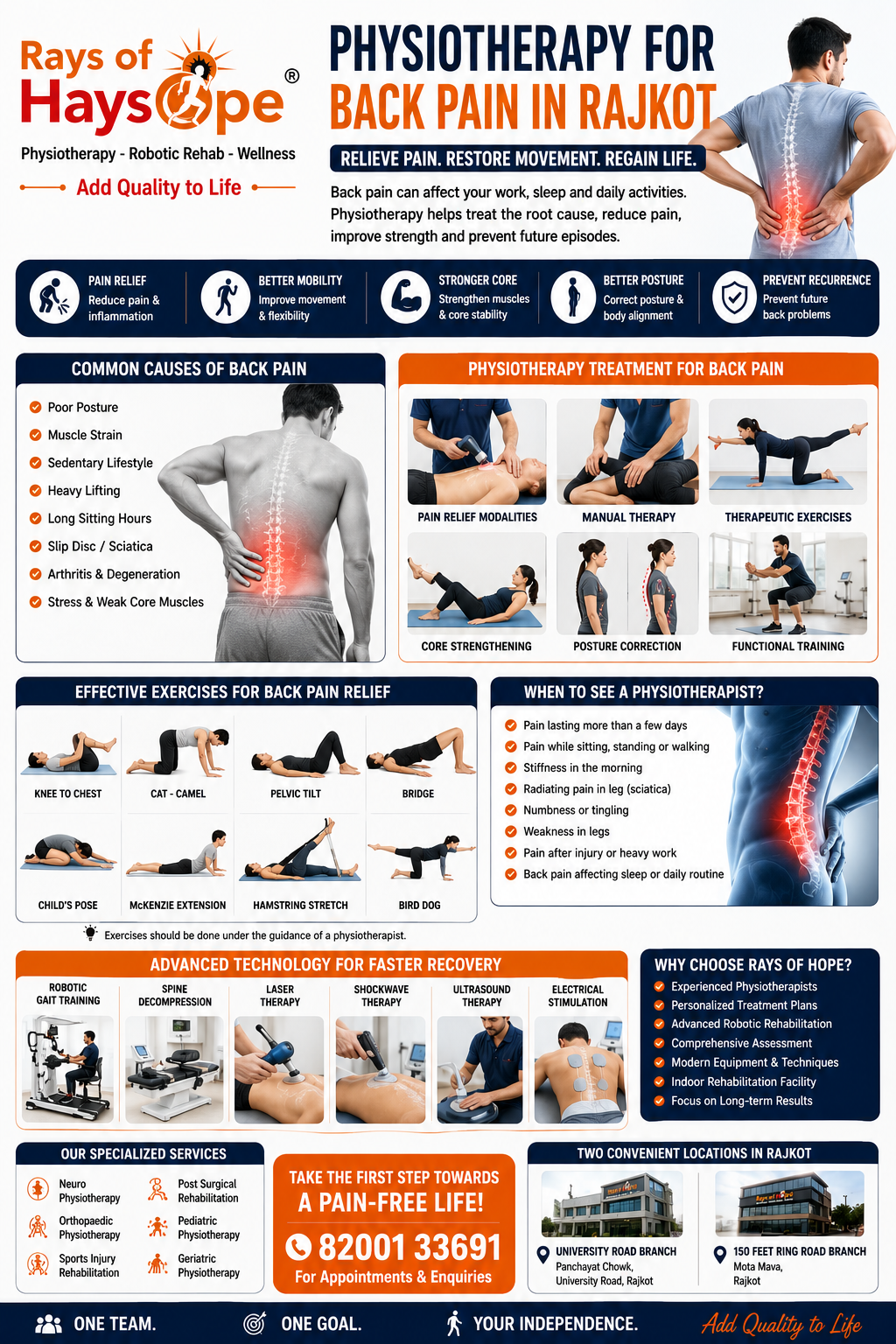
Physiotherapy for Back Pain in Rajkot: Causes, Treatment, Exercises & When to See a Physiotherapist
Back pain is one of the most common reasons people seek physiotherapy. It can affect young adults, office workers, athletes, homemakers, older adults and people recovering from surgery or injury.
Back pain can range from a mild temporary discomfort to persistent pain that interferes with sleep, walking, sitting, work, exercise and everyday activities.
The good news is that many forms of low back pain can be managed successfully with appropriate assessment, education, exercise and rehabilitation. The World Health Organization identifies low back pain as the world's leading cause of disability and notes that rehabilitation is central to helping people return to meaningful activities and improve function.
At Rays of Hope Physiotherapy, Robotic Rehabilitation & Wellness Center, Rajkot, our approach is to identify the factors contributing to the patient's back pain and develop a personalized rehabilitation program focused on pain reduction, movement restoration, strength, function and long-term self-management.
What Is Back Pain?
Back pain refers to discomfort anywhere in the region between the lower ribs and the buttocks. It may be felt centrally over the spine or more to one side.
The pain may be:
Dull or aching
Sharp
Burning
Tight or stiff
Intermittent
Constant
Worse with prolonged sitting or standing
Worse with certain movements
Associated with pain travelling into the leg
Low back pain can be classified by duration as:
Acute: less than 6 weeks
Subacute: 6–12 weeks
Chronic: more than 12 weeks
WHO reports that approximately 90% of low back pain is non-specific, meaning that a single specific structural cause cannot be confidently identified.
This is important because back pain does not automatically mean that there is serious damage to the spine.
Why Does Back Pain Occur?
Back pain can have many contributing factors.
1. Prolonged Sitting
Long periods of sitting, particularly with limited movement throughout the day, can contribute to stiffness and reduced physical conditioning.
Common examples include:
Desk workers
Computer professionals
Students
Drivers
People working from home
The problem is often not simply "bad posture," but a combination of prolonged static positions, low physical activity, reduced strength and individual movement habits.
2. Muscle Strain
Sudden lifting, repetitive activity or an unaccustomed increase in physical workload can irritate muscles and other tissues around the lower back.
3. Poor Physical Conditioning
Weakness or reduced endurance in the trunk, hips and lower limbs may make certain physical tasks more difficult.
This does not mean that one particular "core muscle" is necessarily the cause of pain. A physiotherapist should assess the person's overall movement and functional capacity.
4. Heavy Lifting
Repeated lifting, especially when combined with fatigue, poor load management or sudden increases in workload, can contribute to back symptoms.
Learning safe lifting and load-management strategies can be more useful than simply being told to "never bend your back."
5. Sedentary Lifestyle
Low levels of physical activity are associated with increased risk of low back pain and reduced physical capacity. WHO recommends maintaining physical activity and healthy lifestyle habits as part of low-back-pain self-management.
6. Age-Related Changes
As people age, changes can occur in the discs, joints and other spinal structures.
However, imaging findings are not always directly responsible for pain. Degenerative findings can also occur in people without symptoms.
Therefore, treatment should focus on the person and their functional problems, rather than an MRI report alone.
What About Slip Disc, Disc Bulge or Sciatica?
Many patients are told that they have a "slip disc" after an MRI.
A disc problem may sometimes irritate or compress a spinal nerve and cause symptoms such as:
Back pain
Buttock pain
Leg pain
Tingling
Numbness
Weakness
This type of nerve-related leg pain is commonly called sciatica.
However, not every disc bulge causes symptoms, and not every person with back pain requires an MRI.
A proper clinical assessment helps determine whether imaging or referral is appropriate.
Common Types of Back Pain
Mechanical Low Back Pain
Pain related to movement, loading and physical function without a specific serious underlying disease.
Sciatica / Radicular Pain
Pain that travels from the back or buttock into the leg and may be accompanied by tingling, numbness or weakness.
Disc-Related Pain
Symptoms may be associated with a lumbar disc problem and require individual assessment.
Post-Surgical Back Rehabilitation
Patients recovering from appropriate spinal procedures may require carefully progressed physiotherapy according to the surgeon's instructions.
Chronic Low Back Pain
Pain persisting for more than three months may require a broader rehabilitation approach involving physical, psychological and lifestyle factors.
WHO's chronic low-back-pain guideline emphasizes person-centred, holistic management rather than relying on a single intervention.
When Should You See a Physiotherapist?
You may benefit from physiotherapy assessment when back pain is affecting:
Sitting
Standing
Walking
Sleeping
Working
Exercise
Sports
Household activities
Bending or lifting
Daily independence
You do not necessarily need to wait until the pain becomes severe before seeking professional assessment.
Early education and appropriate activity can help prevent unnecessary fear and prolonged inactivity.
When Is Back Pain an Emergency?
Most back pain is not caused by a serious condition. However, certain symptoms require urgent medical assessment.
Seek urgent medical attention if back pain is associated with symptoms such as:
New loss of bladder or bowel control
Numbness around the groin or saddle region
Rapidly progressing weakness in the legs
Severe neurological deterioration
Significant trauma
Fever or signs of serious infection
Unexplained major weight loss
History of cancer with new concerning symptoms
Severe unexplained pain or other systemic symptoms
These symptoms should not be managed by physiotherapy alone.
Clinical guidelines emphasize the importance of screening for serious pathology and recognizing neurological emergencies such as cauda equina syndrome.
How Does a Physiotherapist Assess Back Pain?
A good physiotherapy assessment goes beyond asking, "Where does it hurt?"
The physiotherapist may evaluate:
Pain
Location
Intensity
Irritability
Behaviour of symptoms
Aggravating factors
Relieving factors
Movement
Lumbar movement
Hip mobility
Thoracic mobility
Functional movement
Strength
Trunk
Hip
Lower limb
Neurological Function
When indicated:
Sensation
Reflexes
Muscle strength
Neural signs
Functional Capacity
Sitting
Standing
Walking
Squatting
Bending
Lifting
Stairs
Lifestyle & Work
The physiotherapist may also discuss:
Work demands
Exercise habits
Sleep
Stress
Physical activity
Ergonomics
Fear of movement
This creates a more complete picture of the patient's condition.
Physiotherapy Treatment for Back Pain
There is no single best treatment for every patient.
A personalized rehabilitation program may include several components.
1. Education
Understanding back pain is an important part of recovery.
Patients may be educated about:
Their symptoms
Safe movement
Activity modification
Exercise
Workload management
Recovery expectations
Self-management
Education can reduce unnecessary fear and help patients remain appropriately active.
2. Therapeutic Exercise
Exercise is one of the most important components of modern back-pain rehabilitation.
Depending on the individual, exercises may target:
Mobility
Strength
Endurance
Core control
Hip strength
Flexibility
Balance
Aerobic capacity
Functional movement
WHO's guideline for chronic primary low back pain includes structured exercise approaches such as strengthening, stretching/mobility, aerobic exercise, motor-control exercise and mixed exercise programs among the physical interventions considered for management.
3. Manual Therapy
Hands-on treatment may be appropriate for selected patients.
It can include:
Joint mobilization
Soft-tissue techniques
Manual stretching
Movement-based techniques
However, manual therapy should generally be considered as part of a broader rehabilitation program, rather than the only treatment.
WHO recommends a holistic approach for chronic primary low back pain rather than relying on isolated interventions.
4. Strength & Core Rehabilitation
The goal is not simply to "strengthen the core."
A complete program may address:
Abdominal and trunk endurance
Hip strength
Gluteal strength
Lower-limb strength
Trunk control
Functional lifting capacity
The exercises are progressed according to the patient's ability.
5. Posture & Ergonomic Training
Posture is only one part of the picture.
We also consider:
How long you sit
How frequently you move
Desk setup
Chair height
Screen position
Lifting technique
Workload
Break frequency
A good ergonomic strategy allows the person to change positions and move regularly, rather than trying to maintain one "perfect posture" all day.
6. Functional Training
The final goal of physiotherapy is not simply to perform exercises inside the clinic.
Patients need to return to real-life activities.
Functional training may include:
Sit-to-stand
Squatting
Lifting
Carrying
Walking
Stair climbing
Work-specific tasks
Sports-specific movements
7. Gradual Return to Physical Activity
One of the most important principles in back-pain recovery is avoiding unnecessary prolonged inactivity.
Depending on the condition, patients may gradually return to:
Walking
Cycling
Gym exercise
Swimming
Yoga
Sports
Work activities
The exact progression should be individualized.
Exercises Commonly Used for Back Pain
Exercises should be selected according to the individual's symptoms and assessment. There is no universal exercise routine that is appropriate for every person with back pain.
Examples that may be incorporated into suitable programs include:
Pelvic Tilts
Gentle movement to develop awareness and control of the pelvis and lumbar region.
Bridge
Strengthens the hip and trunk musculature while training controlled movement.
Bird Dog
Challenges trunk stability and coordination while the limbs move.
Cat-Camel
Provides gentle spinal movement and can be useful for mobility in selected patients.
Knee-to-Chest
May be used as a gentle mobility exercise for some presentations.
Hip & Hamstring Mobility
May be included when reduced mobility contributes to functional limitations.
Core Control Exercises
Progressive trunk exercises can improve endurance and control.
Walking
Walking is often a simple and accessible form of physical activity and can be progressively increased according to tolerance.
Important: Exercises shown online are not automatically appropriate for every back-pain condition. A physiotherapist should modify exercise selection, repetitions, intensity and progression according to the patient's symptoms and clinical findings.
Exercises That May Not Be Appropriate for Everyone
A common mistake is searching for a single "best exercise for back pain."
There isn't one.
For example, an exercise that feels helpful to one person may aggravate another person's symptoms.
The same applies to:
Deep stretching
Heavy lifting
Repeated bending
High-impact exercise
Spinal extension
Spinal flexion
The correct exercise is the one that is appropriate for the individual's diagnosis, symptoms, goals and current capacity.
Can Physiotherapy Cure Back Pain Permanently?
It is better to think in terms of management, recovery and recurrence reduction rather than promising a permanent cure.
Many episodes of acute low back pain improve over time, while some people experience recurrent or persistent symptoms. WHO notes that most acute episodes recover well, but some can become chronic.
Physiotherapy can help patients:
Reduce pain
Restore movement
Improve strength
Improve physical capacity
Return to activities
Understand their symptoms
Develop self-management strategies
Long-term results often depend on maintaining appropriate physical activity and addressing relevant lifestyle and occupational factors.
How Long Does Back-Pain Physiotherapy Take?
There is no fixed treatment duration.
Recovery depends on:
Cause and presentation
Duration of symptoms
Severity
Physical capacity
Neurological involvement
Work demands
Sleep
Activity levels
Previous episodes
Treatment adherence
Individual response
Some people improve within a few sessions, while persistent or complex conditions may require a longer rehabilitation program.
A good physiotherapist should reassess progress regularly and adjust the treatment plan.
Does Back Pain Always Require an MRI?
No.
Many cases of uncomplicated low back pain can be assessed clinically without immediate imaging.
Imaging may be appropriate when:
Serious pathology is suspected
Significant neurological deficits are present
Symptoms are persistent or atypical
The result is likely to change management
A medical specialist recommends it
An MRI report should always be interpreted in the context of the patient's symptoms and clinical examination.
Physiotherapy vs Painkillers for Back Pain
Pain medication may sometimes be used under medical guidance, but medication alone does not address physical function, movement, conditioning or self-management.
WHO's low-back-pain guidance emphasizes non-pharmacological care such as education and exercise, with medication decisions individualized to the patient and clinical context.
For persistent symptoms, a multimodal rehabilitation approach may be more useful than relying on a single intervention.
Role of Advanced Physiotherapy Technology
Modern physiotherapy may incorporate technology when clinically appropriate.
At Rays of Hope, our broader rehabilitation technology platform includes robotic rehabilitation systems, virtual reality, balance and functional training systems, and other technology-assisted rehabilitation approaches.
For back-pain patients, technology may be considered selectively as an adjunct to active rehabilitation rather than as a replacement for exercise and clinical assessment.
Our facility also lists treatments such as shockwave therapy, laser therapy, spinal decompression and electrotherapy among its physiotherapy services.
Important:
Not every technology is appropriate for every patient.
Treatment should be selected after clinical assessment.
What About Spinal Decompression?
Spinal decompression is promoted for several back and neck conditions, but it should not be presented as a universal solution for low back pain.
The choice of treatment depends on:
Diagnosis
Symptoms
Neurological findings
Medical history
Treatment goals
Clinical evidence
WHO's chronic low-back-pain guideline specifically advises against routine use of traction for most people with chronic primary low back pain.
Therefore, any decompression or traction-based treatment should be considered selectively and not as a guaranteed treatment for every disc problem or back-pain patient.
Back Pain Prevention: What Can You Do?
Prevention does not mean avoiding every movement that could potentially cause pain.
Instead, focus on building physical capacity and healthy movement habits.
Stay Active
Regular physical activity is important.
Build Strength
Progressive strengthening can improve physical capacity.
Break Up Long Sitting
Stand, walk and change position regularly.
Maintain Healthy Body Weight
When appropriate, weight management can support overall health and physical function.
Sleep Well
Poor sleep can influence pain sensitivity, recovery and well-being.
Manage Workload
Avoid sudden large increases in physical activity or training.
Learn Safe Lifting Strategies
Use appropriate technique and gradually build tolerance to lifting.
WHO recommends physical activity, healthy weight, good sleep, workplace ergonomic adjustments and self-management as part of strategies for managing and reducing the impact of low back pain.
Why Choose Rays of Hope for Back Pain Physiotherapy in Rajkot?
Rays of Hope Physiotherapy, Robotic Rehabilitation & Wellness Center provides physiotherapy and rehabilitation services across two Rajkot locations.
Our official website lists low back pain, neck pain, knee pain, hip pain and other musculoskeletal conditions among the conditions treated, alongside specialized neurological, orthopaedic and sports rehabilitation services.
Our approach includes:
Comprehensive Assessment
Understanding the patient's symptoms, movement, strength and functional limitations.
Personalized Treatment
Treatment plans are developed according to individual goals rather than using one standard protocol.
Exercise-Based Rehabilitation
Progressive movement, strength, mobility and functional training.
Advanced Equipment
Modern physiotherapy and rehabilitation equipment can be incorporated when clinically appropriate.
Multidisciplinary Care
Patients with complex needs can benefit from coordination across relevant rehabilitation specialties.
Home Physiotherapy
Rays of Hope also provides physiotherapy at home for patients who require doorstep care.
Two Convenient Rays of Hope Locations in Rajkot
📍 University Road Branch
Panchayat Chowk, University Road, Rajkot
📍 Mota Mava Branch
Victoria Gardens Road, opposite Sunshine International School, beside Floranza, Rajkot
The official contact page currently lists both branches and their respective contact information.
📞 Appointment
+91 82001 33691
Frequently Asked Questions About Back Pain Physiotherapy
1. Is physiotherapy good for lower back pain?
For many types of low back pain, physiotherapy can be an important component of rehabilitation, particularly when it includes education, appropriate exercise and progressive functional training. WHO recommends physical rehabilitation approaches for low back pain according to individual needs.
2. Can physiotherapy help sciatica?
Physiotherapy may help selected people with sciatica by addressing pain, mobility, strength and functional limitations. However, neurological symptoms should be assessed carefully.
3. Should I rest completely when I have back pain?
Usually, prolonged complete bed rest is not the goal. Appropriate activity is generally encouraged, provided there are no medical reasons to restrict it. The activity level should be adjusted according to symptoms and clinical findings.
4. Can I exercise if my back hurts?
Often yes, but the appropriate exercise depends on the presentation. Exercise should be modified according to pain behaviour, neurological findings, physical capacity and goals.
5. Does every disc bulge require surgery?
No. Imaging findings alone do not determine whether surgery is required. The decision depends on symptoms, neurological status, severity, duration and medical assessment.
6. How many physiotherapy sessions are needed?
There is no universal number. The treatment duration depends on the condition and response to rehabilitation.
7. Can back pain come back after physiotherapy?
Yes. Recurrence can occur. Long-term management therefore includes maintaining physical activity, strength, mobility and healthy lifestyle habits.
8. When should I see a doctor instead of a physiotherapist?
Urgent medical assessment is appropriate for symptoms such as new bladder/bowel dysfunction, saddle numbness, progressive significant weakness, major trauma, fever with concerning symptoms or other signs suggesting serious disease.
Final Takeaway
Back pain should not automatically be interpreted as a sign of serious spinal damage.
For many people, the most effective approach is a combination of:
Accurate Assessment
↓
Education
↓
Appropriate Exercise
↓
Strength & Mobility Training
↓
Functional Rehabilitation
↓
Gradual Return to Activity
↓
Long-Term Self-Management
The goal of physiotherapy is not simply to make the pain disappear for a few days.
The goal is to help you move better, become stronger, return to meaningful activities and develop the confidence to manage your back in the long term.
At Rays of Hope Physiotherapy, Robotic Rehabilitation & Wellness Center, Rajkot, our philosophy is:
One Team. One Goal. Your Independence.
Add Quality to Life
Rays of Hope Physiotherapy – Robotic Rehab – Wellness
📍 University Road, Panchayat Chowk, Rajkot
📍 Mota Mava, Rajkot
📞 +91 82001 33691