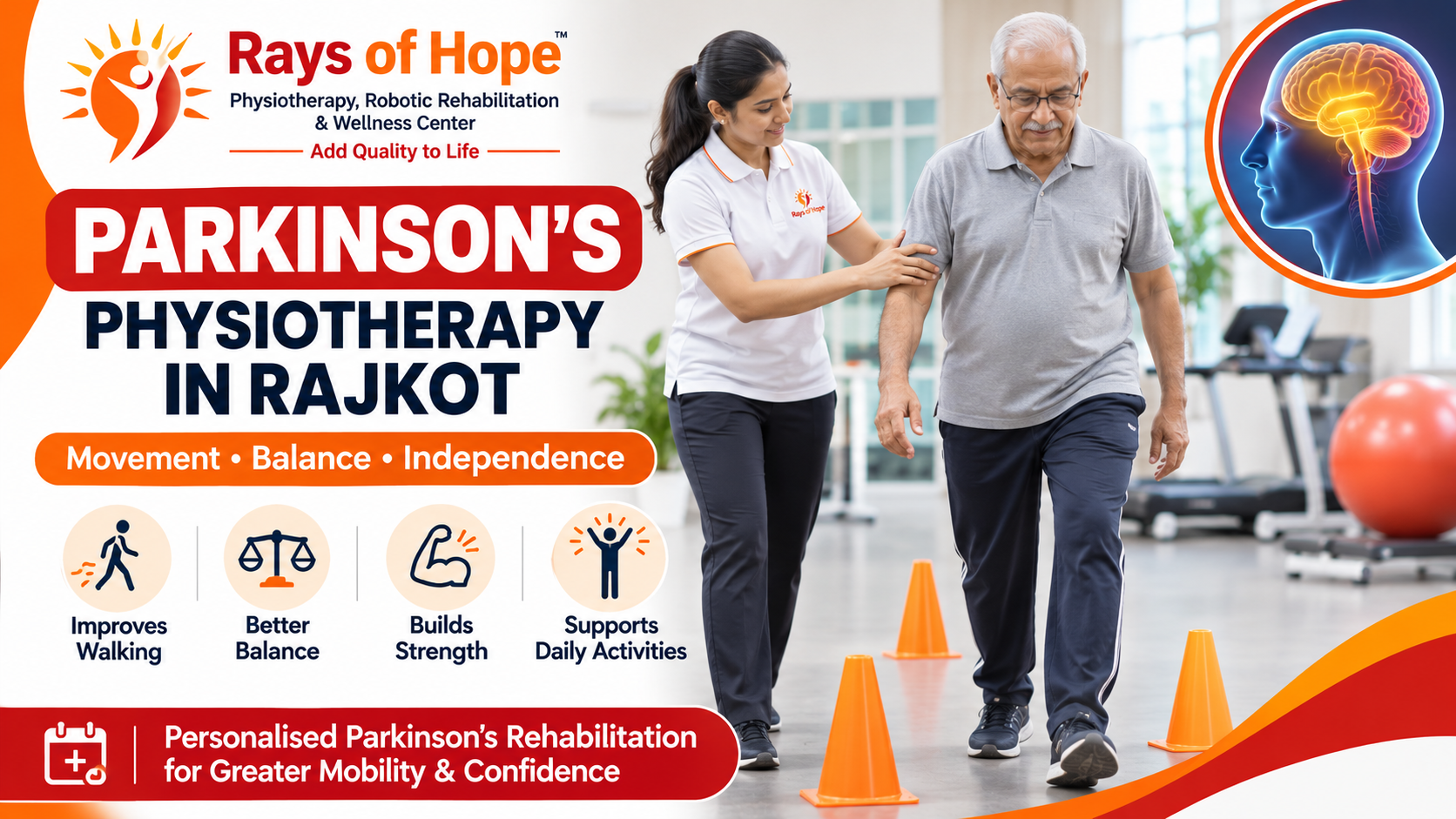
Parkinson’s Physiotherapy in Rajkot: Exercises, Walking & Balance Rehabilitation
Parkinson’s disease is a progressive neurological condition that affects movement and can make everyday activities increasingly challenging. People may experience slow movements, stiffness, tremors, difficulty walking, reduced balance and changes in posture.
Although Parkinson’s disease currently has no cure, appropriate medical management and specialised physiotherapy can help many people maintain mobility, practise daily activities, improve physical capacity and work toward greater independence.
If you are searching for Parkinson’s physiotherapy in Rajkot, this guide explains the symptoms of Parkinson’s disease, the role of physiotherapy, useful exercise categories and how a personalised rehabilitation programme may help.
At Rays of Hope Physiotherapy, Robotic Rehabilitation & Wellness Center, Rajkot, neurological rehabilitation is tailored to individual needs, movement difficulties and functional goals.
What Is Parkinson’s Disease?
Parkinson’s disease is a neurological disorder associated with the loss or dysfunction of dopamine-producing nerve cells in the brain. Dopamine plays an important role in controlling smooth, coordinated movement.
As the condition progresses, a person may experience changes in movement, balance, walking, speech and daily function. Symptoms and progression vary considerably from person to person.
Parkinson’s disease is not simply a normal part of ageing. Medical assessment is important when symptoms suggest a neurological movement disorder.
Common Symptoms of Parkinson’s Disease
Parkinson’s disease can cause motor and non-motor symptoms.
Motor symptoms
Tremor: Shaking, often beginning in one hand or limb, particularly when resting.
Bradykinesia: Slowness of movement that may affect dressing, eating, writing, turning in bed or initiating walking.
Muscle rigidity: Stiffness that can make movement uncomfortable or reduce the ease of daily activities.
Balance difficulties: Reduced postural responses can increase the risk of falls, particularly as the condition progresses.
Short, shuffling steps: Walking may become slower, with reduced arm swing and smaller steps.
Freezing of gait: A temporary feeling that the feet are stuck to the floor, often during turns, doorways or when starting to walk.
Postural changes: Some individuals develop a forward-flexed posture or difficulty maintaining an upright position.
Non-motor symptoms
People with Parkinson’s disease may also experience sleep disturbances, constipation, fatigue, anxiety, depression, cognitive changes, reduced sense of smell or blood pressure changes when standing.
These symptoms require appropriate medical attention and may benefit from coordinated multidisciplinary care.
Why Is Early Parkinson’s Rehabilitation Important?
Physiotherapy should not be reserved only for people who have severe mobility problems. Early assessment can help identify changes in movement, activity levels, balance and physical conditioning.
A Parkinson’s-specific physiotherapy programme may help people:
Maintain strength and physical endurance.
Practise larger, more deliberate movements.
Improve walking speed and step length where possible.
Develop balance and movement strategies.
Practise turning, transfers and everyday activities.
Reduce avoidable fall risks.
Maintain confidence and participation in meaningful activities.
The goals are individual. Physiotherapy does not cure Parkinson’s disease or guarantee that progression will stop, but exercise and movement training can support function and quality of life.
NICE guidance recommends Parkinson’s-specific physiotherapy for people experiencing balance or motor-function problems and encourages early referral for assessment and advice. NICE Parkinson’s disease guidance.
How Can Physiotherapy Help Parkinson’s Disease?
1. Gait Training and Walking Rehabilitation
Changes in walking are common in Parkinson’s disease. A person may take shorter steps, walk more slowly, reduce arm swing or struggle to turn safely.
Gait training may include:
Practising step length and walking rhythm.
Walking with appropriate visual or auditory cues.
Practising starts, stops and controlled turns.
Improving arm swing and trunk movement.
Training safe walking in relevant everyday environments.
Practising changes in direction under supervision.
The therapist selects techniques according to the person’s symptoms, attention, balance and walking ability.
2. Balance Training and Fall-Risk Reduction
Balance problems may develop because of changes in postural control, movement speed, strength and the ability to react to a loss of balance.
A programme may include:
Supported weight shifting.
Static and dynamic balance exercises.
Controlled stepping in different directions.
Sit-to-stand practice.
Turning and transfer training.
Functional reaching activities.
Appropriate walking-aid assessment and education.
More challenging exercises should be supervised when a person has a history of falls, freezing episodes or significant balance impairment.
3. Amplitude-Based Movement Training
Some people with Parkinson’s disease gradually make smaller movements without fully realising it. This can affect walking, reaching, turning, dressing and other tasks.
Amplitude-based training focuses on practising larger, purposeful movements with attention to posture, movement range and effort.
Exercises may involve:
Large arm movements.
Reaching in different directions.
Bigger steps during walking.
Repeated sit-to-stand practice.
Controlled trunk rotation.
Functional movements related to dressing or household tasks.
The programme should be selected and supervised by a clinician familiar with Parkinson’s rehabilitation. Specialised protocols may require additional training.
4. Strength and Resistance Training
Muscle weakness and reduced physical activity can make everyday tasks more difficult.
Depending on ability and medical status, strengthening may include:
Sit-to-stand repetitions.
Supported squats.
Lower-limb resistance exercises.
Hip and trunk strengthening.
Upper-limb strengthening.
Progressive functional training.
Resistance, repetitions and rest periods should be adapted to fatigue, cardiovascular health, balance and movement control.
5. Flexibility and Mobility Exercises
Stiffness and reduced movement can affect posture, reaching and turning.
A therapist may prescribe gentle exercises for the trunk, shoulders, hips, ankles and other restricted areas. The aim is to maintain comfortable movement and improve function rather than force joints into painful positions.
6. Freezing-of-Gait Strategies
Freezing can occur when initiating walking, turning, approaching doorways or moving through crowded spaces.
Strategies may include:
Pausing and resetting posture before stepping.
Using a visual line or target to step over.
Following a rhythmic auditory cue when appropriate.
Breaking a turn into smaller, deliberate steps.
Reducing distractions during difficult walking tasks.
Practising strategies in a safe, supervised environment.
Not every cue works for every person. A physiotherapist can help identify effective strategies and practise them safely.
7. Aerobic Exercise and Physical Conditioning
Appropriate aerobic exercise can help maintain cardiovascular fitness, endurance and general health.
Possible activities include walking, stationary cycling or other suitable exercises selected according to the person’s mobility and medical condition.
Intensity and duration should be individualised. People with significant balance problems, faintness on standing, heart conditions or frequent falls should receive clinical guidance before increasing exercise intensity.
Clinical practice guidelines support aerobic exercise, progressive resistance training, balance training, gait training, external cueing and task-specific practice for appropriate individuals with Parkinson’s disease. American Physical Therapy Association clinical practice guideline.
Parkinson’s Exercises: What Can Be Practised?
The following are examples of exercise categories. They are not a universal home programme, and some may be unsuitable without supervision.
Seated marching: Practise alternating leg lifts while seated securely, if comfortable and safe.
Sit-to-stand: Practise standing up from a stable chair and sitting down with controlled movement. Use assistance if required.
Supported weight shifting: With a stable support and supervision where necessary, gently shift weight from one side to the other.
Large reaching movements: Reach forward or sideways within a comfortable range while maintaining a safe position.
Walking practice: Practise controlled steps on a clear, level surface with the recommended walking aid if prescribed.
Ankle and lower-limb mobility: Gentle movements may help maintain comfortable range of motion.
Exercise difficulty should progress gradually. A person with recurrent falls or freezing episodes should not practise challenging balance exercises alone.
Robotic Rehabilitation for Parkinson’s Disease: Is It Suitable?
Technology-assisted rehabilitation may be considered for selected patients when it supports a defined functional goal. Depending on the individual assessment and service availability, rehabilitation may use balance-training systems, gait-training devices, interactive exercise or other technology-assisted approaches.
At Rays of Hope, the website describes robotic rehabilitation systems, balance-training technology, gait-related rehabilitation and virtual-reality or gaming-based therapy. Explore robotic rehabilitation.
However, robotic therapy is not necessary for every person with Parkinson’s disease, and no device should be presented as a cure. Technology should complement an appropriate programme of exercise, task-specific practice, education and medical management.
Can Physiotherapy Prevent Falls in Parkinson’s Disease?
Physiotherapy can address several modifiable fall-risk factors, including strength, balance, gait, turning strategies and transfer techniques. However, it cannot eliminate all fall risk.
A fall-prevention plan may also involve:
Reviewing previous falls and near-falls.
Assessing freezing and turning difficulties.
Reviewing footwear and walking aids.
Identifying home hazards, loose rugs and poor lighting.
Practising safe transfers.
Discussing dizziness or faintness with the medical team.
Reviewing medication-related movement fluctuations with the treating doctor.
People with frequent falls, sudden deterioration or new neurological symptoms should receive medical assessment.
What Is the Role of Family Members and Caregivers?
Family members can play an important role in supporting safe activity and consistent rehabilitation.
Helpful approaches include:
Allowing enough time for movement and daily tasks.
Avoiding rushing a person who is experiencing freezing.
Keeping walking routes clear.
Encouraging prescribed exercises without forcing movement.
Following the therapist’s guidance on assistance and transfers.
Observing changes in walking, swallowing, cognition or daily function.
Supporting medical appointments and medication routines.
Caregivers should learn safe assistance techniques rather than pulling a person by the arms or attempting unsafe transfers.
Parkinson’s Disease and Medication Timing
Some people experience periods when their medication works well and movement is easier, followed by periods when stiffness, slowness or freezing becomes more pronounced.
Where practical, rehabilitation sessions may be planned with the treating team to account for these fluctuations. Patients should follow their prescribed medication schedule and should not change or stop Parkinson’s medication without medical advice.
Sudden severe deterioration, new weakness, acute confusion or other concerning changes require prompt medical assessment.
When Should You Seek Medical Attention?
Seek urgent medical care for sudden weakness, a new facial droop, sudden speech difficulty, a sudden severe headache, a serious fall or head injury, or a rapid change in consciousness. These should not automatically be attributed to Parkinson’s disease.
New swallowing difficulty, repeated choking, fainting, frequent falls or rapidly worsening mobility should also be reported promptly to the treating healthcare team.
Parkinson’s Physiotherapy at Rays of Hope, Rajkot
At Rays of Hope Physiotherapy, Robotic Rehabilitation & Wellness Center, Rajkot, neurological rehabilitation can be planned around an individual’s mobility, balance, strength, walking and daily activity goals.
Depending on clinical assessment and the services required, rehabilitation may include:
Gait and functional mobility training.
Balance and postural-control exercises.
Strength and endurance training.
Task-specific movement practice.
Strategies for freezing and turning.
Caregiver education and home-safety guidance.
Technology-assisted rehabilitation when clinically appropriate.
Coordination with the treating neurologist and other healthcare professionals when needed.
People with Parkinson’s disease may have different needs at different stages. The rehabilitation programme should therefore be reviewed and adapted as symptoms and goals change.
Frequently Asked Questions
Can physiotherapy cure Parkinson’s disease?
No. Physiotherapy does not cure Parkinson’s disease. It can help address movement-related difficulties and support physical function, mobility and participation in daily activities.
When should a person with Parkinson’s start physiotherapy?
A person can benefit from an early assessment, even before major mobility limitations develop. Physiotherapy is particularly important when walking, balance, posture or daily movement becomes difficult.
Which exercises are best for Parkinson’s disease?
The programme may include gait training, balance exercises, strengthening, aerobic activity, flexibility and task-specific movement practice. The best combination depends on the individual’s symptoms, health and fall risk.
Can robotic rehabilitation help Parkinson’s patients?
Selected technology-assisted systems may support gait, balance or movement practice. Their suitability depends on the person’s clinical condition and goals. They should be used as part of an individualised rehabilitation programme rather than as a replacement for comprehensive care.
Can Parkinson’s patients improve their walking?
Many people can improve or maintain aspects of walking through appropriate gait training, cueing, strengthening and exercise. Results vary, and progressive symptoms may require ongoing adjustments to the rehabilitation plan.
Where can I get Parkinson’s physiotherapy in Rajkot?
Contact Rays of Hope Physiotherapy, Robotic Rehabilitation & Wellness Center, Rajkot, to enquire about neurological rehabilitation assessment and available services.
Book a Parkinson’s Rehabilitation Consultation in Rajkot
Parkinson’s disease can affect movement, independence and confidence, but appropriate medical care, regular physical activity and individualised rehabilitation can help people work toward meaningful functional goals.
Rays of Hope Physiotherapy, Robotic Rehabilitation & Wellness Center, Rajkot
Appointment contact: +91 82001 33691
University Road Branch: Near Khodiyar Dairy, Panchayat Chowk, University Road, Rajkot, Gujarat.
Mota Mava Branch: Opp. Sunshine School, Behind Karan Arjun Party Plot, New Ring Road, Rajkot, Gujarat.
Website: https://www.raysofhope.co.in/
Rays of Hope — Add Quality to Life.
Medical disclaimer: This article provides general educational information and does not replace assessment by a neurologist or qualified rehabilitation professional. Exercise and rehabilitation plans should be adapted to the individual’s symptoms, medical status and fall risk.