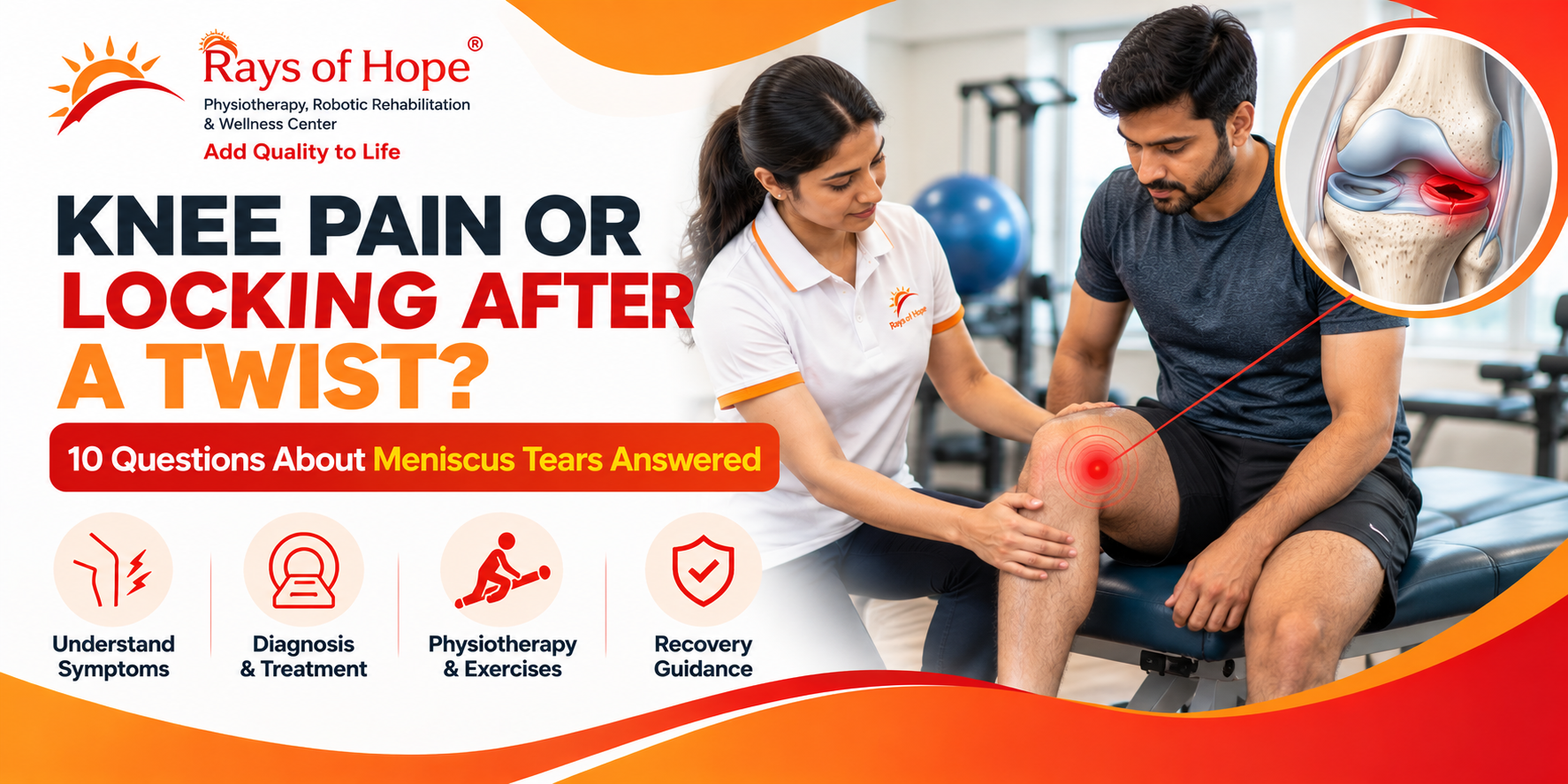
Why Does My Knee Hurt or Lock After a Twisting Injury?
Have you experienced knee pain, swelling, clicking or difficulty straightening your knee after twisting it during sports, climbing stairs or getting up from a seated position? These symptoms may be associated with a meniscus tear, a common knee injury that can affect walking, exercise and daily activities.
At Rays of Hope Physiotherapy, Robotic Rehabilitation & Wellness Center, Rajkot, rehabilitation is planned according to the individual’s symptoms, examination findings, functional limitations and medical or surgical advice.
In this guide, we answer 10 common questions about meniscus injuries, diagnosis, treatment and physiotherapy.
Q1. What is a meniscus tear?
The meniscus is a C-shaped piece of tough, flexible cartilage inside the knee. Each knee has two menisci—one on the inner side and one on the outer side.
They help distribute loads across the knee, absorb shock and support joint stability. A meniscus can tear when the knee twists under load, during sports, or sometimes through gradual age-related changes.
The severity and location of the tear influence the symptoms and treatment options.
NHS
+1
Q2. What are the common symptoms of a meniscus injury?
Symptoms may include:
Pain along the inner or outer joint line of the knee.
Swelling that develops over several hours or days.
Stiffness or difficulty bending and straightening the knee.
Clicking or catching sensations.
A feeling that the knee may give way.
Pain during squatting, turning or pivoting.
Important: These symptoms do not confirm a meniscus tear on their own. Ligament injuries, cartilage problems and other knee conditions can produce similar symptoms.
Q3. How does a meniscus tear happen?
Common causes include:
Sports injuries: Sudden turning or pivoting while the foot is planted.
Twisting accidents: Turning quickly while standing or carrying a load.
Deep squatting: Particularly when combined with rotation or heavy loading.
Age-related changes: The meniscus can become more vulnerable to injury over time.
A meniscus tear may also occur alongside an anterior cruciate ligament (ACL) injury. A proper assessment is important when significant swelling, instability or difficulty bearing weight occurs.
AAOS
+1
Q4. How is a meniscus tear diagnosed?
A clinician will typically ask how the injury occurred, where the pain is located and whether the knee swells, catches or locks.
Assessment may include:
Checking knee swelling and tenderness.
Measuring the range of motion.
Assessing walking, stability and muscle function.
Performing appropriate clinical tests.
Reviewing imaging when indicated.
An MRI may be recommended to assess the meniscus and other soft tissues. Imaging is interpreted alongside symptoms and examination findings; an abnormal scan does not automatically mean surgery is required.
American Academy of Orthopaedic Surgeons
+1
Q5. Can a meniscus tear heal without surgery?
Yes, some meniscus tears can be managed without surgery, but the result depends on the tear’s type, location, size, symptoms, associated injuries and activity requirements.
A clinician may recommend a non-surgical programme when appropriate, which can include activity modification, symptom management and progressive physiotherapy.
Surgical assessment may be important for selected tears, particularly when the knee is genuinely locked, movement is significantly restricted or symptoms persist despite appropriate conservative care. Treatment decisions should be made with an orthopaedic specialist when indicated.
American Academy of Orthopaedic Surgeons
+2
Q6. How can physiotherapy help with meniscus injury rehabilitation?
Physiotherapy aims to improve knee function and help you return safely to everyday activities. Depending on the assessment and treatment plan, rehabilitation may include:
Swelling and pain management: Strategies to reduce irritation and protect the knee.
Range-of-motion exercises: Restoring comfortable movement within permitted limits.
Quadriceps strengthening: Improving the strength of the muscles that support the knee.
Hip and lower-limb strengthening: Supporting movement control and functional capacity.
Balance and neuromuscular training: Improving control during standing, walking and other tasks.
Functional retraining: Gradually progressing activities according to tolerance and clinical milestones.
The programme should be individualised. Exercises that are suitable for one tear may not be appropriate for another, especially after surgery. Rehabilitation following meniscus repair must follow the surgeon’s instructions regarding weight-bearing, knee bending and activity restrictions.
Sage Journals
+2
Q7. Which exercises may be used during recovery?
The appropriate exercises depend on pain, swelling, movement, injury severity and whether surgery has been performed.
Depending on clinical advice, a rehabilitation programme may progress through:
Gentle knee movement within the permitted range.
Quadriceps activation exercises.
Straight-leg raises when appropriate.
Progressive strengthening exercises.
Balance and controlled functional exercises.
Sport-specific drills in later rehabilitation, when suitable.
Do not start deep squats, twisting drills, running or jumping simply because the pain has reduced. Stop an exercise that causes sharp pain, increased swelling or worsening symptoms, and seek guidance from your treating clinician.
After meniscus repair surgery, follow the prescribed protocol rather than using a generic online exercise plan.
Q8. How long does recovery from a meniscus tear take?
There is no single recovery timeline for every meniscus injury.
Recovery depends on the tear, treatment approach, associated injuries, physical demands and progress through rehabilitation.
Non-surgical management: Progress depends on symptoms, strength and functional improvement.
Arthroscopic partial meniscectomy: Recovery is often shorter than after a meniscus repair, but individual variation is substantial.
Meniscus repair: Healing and rehabilitation may take several months, and restrictions can apply during early recovery.
Return to running, work, gym training or sport should be based on appropriate clinical and functional milestones—not just the number of weeks since injury.
AAOS
+2
Q9. When should I see an orthopaedic doctor urgently?
Seek prompt medical assessment if:
You cannot straighten your knee or it appears mechanically locked.
You cannot bear weight after an injury.
Severe pain or substantial swelling develops.
The knee becomes hot and red, particularly with fever.
The knee looks deformed.
You experience new numbness or loss of sensation in the leg or foot.
A truly locked knee should not be forced straight through repeated exercises or manipulation. A clinician should assess the cause and determine the appropriate next step.
NHS
+1
Q10. Where can I get meniscus injury physiotherapy in Rajkot?
At Rays of Hope Physiotherapy, Robotic Rehabilitation & Wellness Center, rehabilitation can be planned around your assessment findings, functional goals and medical advice.
Your programme may focus on restoring comfortable knee movement, improving muscle strength, rebuilding balance and movement control, and progressing towards daily activities or sport where appropriate.
If you have an MRI report, orthopaedic consultation notes or a post-operative rehabilitation protocol, bring them to your appointment.
Book a physiotherapy assessment in Rajkot
Rays of Hope — Add Quality to Life

University Road Branch
Near Khodiyar Dairy, Panchayat Chowk, University Road, Rajkot, Gujarat.

Mota Mava Branch
Opp. Sunshine School, Behind Karan Arjun Party Plot, New Ring Road, Rajkot, Gujarat.
Call: +91 82001 33691
Website: www.raysofhope.co.in
Medical disclaimer: This article is for general education and does not replace an individual medical assessment. Treatment and rehabilitation should be tailored to the specific injury and any surgical instructions.