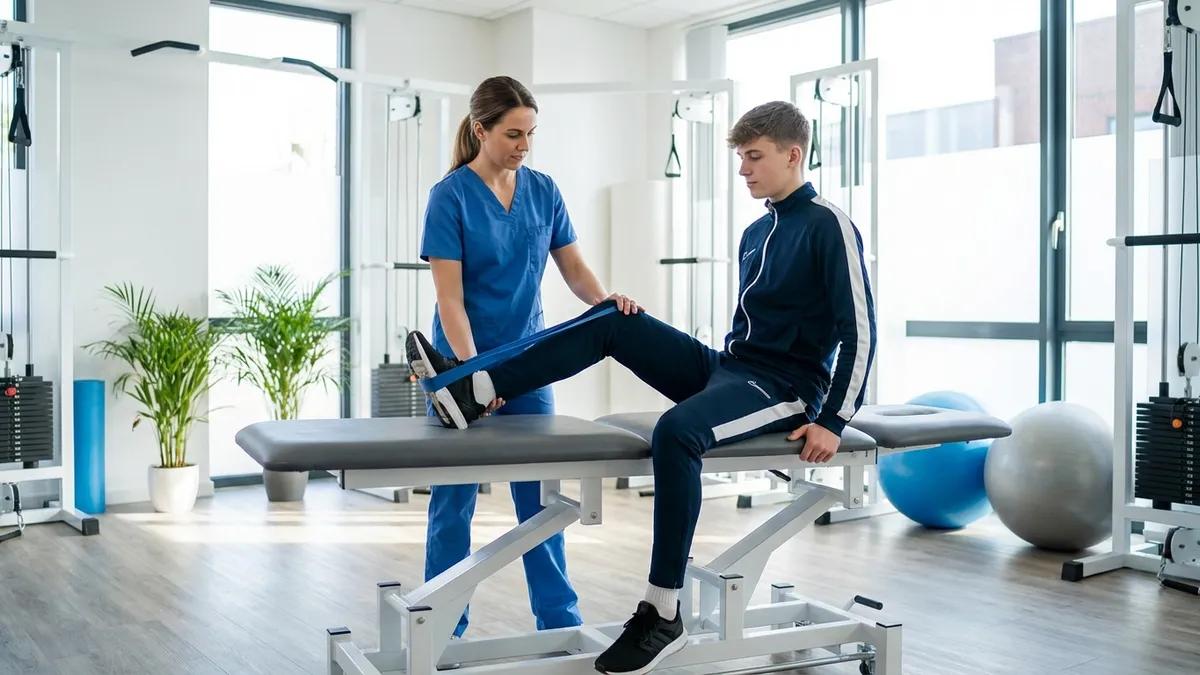
ACL Rehabilitation in Rajkot: Recovery Timeline, Exercises & Physiotherapy After Surgery
An anterior cruciate ligament (ACL) injury can affect walking, climbing stairs, running, jumping and participating in sports. Whether you are a football player, cricket player, gym enthusiast or someone who has injured their knee during daily activities, the right rehabilitation programme can play an important role in restoring knee function and helping you return to your desired activities.
At Rays of Hope Physiotherapy, Robotic Rehabilitation & Wellness Center, Rajkot, rehabilitation planning focuses on the individual’s injury, functional limitations, treatment pathway and recovery goals.
If you are searching for ACL rehabilitation in Rajkot, ACL physiotherapy, knee ligament rehabilitation or physiotherapy after ACL reconstruction, this guide explains the rehabilitation process, important recovery milestones and the role of structured physiotherapy.
What Is an ACL Injury?
The anterior cruciate ligament (ACL) is one of the major ligaments inside the knee joint. It helps control forward movement and rotation of the shinbone in relation to the thighbone and contributes to knee stability during activities such as pivoting, landing, sudden stopping and changing direction.
An ACL injury may occur when a person:
Suddenly changes direction while running.
Lands awkwardly after jumping.
Stops abruptly during a sport.
Twists the knee while the foot remains planted.
Experiences a direct impact or collision involving the knee.
ACL injuries may range from a mild ligament sprain to a partial or complete tear. Other structures, including the meniscus and additional knee ligaments, may also be injured.
Common Signs and Symptoms of an ACL Injury
Symptoms vary according to the severity of the injury and whether other structures are involved.
Common signs include:
A popping sensation at the time of injury.
Rapid swelling around the knee.
Knee pain and difficulty bearing weight.
Reduced knee bending or straightening.
A feeling that the knee is giving way.
Difficulty with sudden turns, running or jumping.
Reduced confidence while walking on uneven ground.
Important: A popping sound does not automatically confirm an ACL tear. Other knee injuries can produce similar symptoms. A clinical assessment is needed to determine the likely cause.
If you cannot bear weight, have significant swelling, experience severe pain or notice a locked knee after an injury, seek prompt medical assessment.
Does Every ACL Tear Require Surgery?
No. ACL reconstruction is not necessary for every person with an ACL injury.
Treatment decisions depend on several factors, including:
Whether the injury is partial or complete.
Whether the knee repeatedly gives way.
Associated meniscal, cartilage or ligament injuries.
The person’s age, activity demands and sporting goals.
Knee stability and response to rehabilitation.
The recommendations of the orthopaedic specialist.
Some people with ACL injuries can achieve satisfactory function through structured, non-surgical rehabilitation and activity modification. Others, particularly those with persistent instability or a need to return to demanding pivoting sports, may be considered for ACL reconstruction.
The decision should be made collaboratively with an orthopaedic specialist and the patient. Physiotherapy is important in both non-surgical management and postoperative recovery.
Why Is Physiotherapy Important After ACL Surgery?
ACL reconstruction repairs the injured knee’s stability by replacing the damaged ligament with a graft. However, surgery alone does not restore muscle strength, balance, coordination, movement quality or confidence.
After surgery, a person may experience:
Quadriceps weakness and muscle loss.
Knee swelling and discomfort.
Difficulty achieving full knee extension.
Reduced knee flexion.
Altered walking patterns.
Poor balance and neuromuscular control.
Reduced tolerance for running, jumping and sports.
A structured rehabilitation programme addresses these problems progressively. Clinical guidelines identify exercise-based rehabilitation as the foundation of recovery after ACL reconstruction, with treatment progression adapted to the individual and the surgeon’s instructions. Aspetar ACL rehabilitation guideline.
ACL Rehabilitation Timeline: What Happens at Each Stage?
Recovery is not identical for everyone. The following stages are a general guide, not a fixed prescription. The timeline may change depending on the surgical procedure, graft type, associated injuries, healing response and progress against functional criteria.
Stage 1: Early Rehabilitation — First 2 Weeks
Main goals: Control swelling, regain knee extension, activate the quadriceps and begin safe mobility.
Depending on the surgical instructions and clinical assessment, rehabilitation may include:
Swelling management and appropriate cold application.
Ankle pumps and circulation exercises.
Gentle knee range-of-motion exercises.
Quadriceps setting exercises.
Straight-leg raises when adequate muscle control is present.
Safe transfers and walking with prescribed support.
Education about wound care precautions, activity and home exercises.
Full knee extension is an important early milestone. Exercises must be modified if they increase pain or swelling or if the surgeon has prescribed restrictions.
Stage 2: Range of Motion and Strength — Approximately Weeks 2–6
Main goals: Improve knee movement, restore walking mechanics and begin progressive strengthening.
Depending on progress, a physiotherapist may introduce:
Progressive knee bending and straightening exercises.
Quadriceps and hamstring strengthening as appropriate.
Sit-to-stand practice.
Supported mini-squats.
Weight-shifting and balance exercises.
Controlled step-up activities.
Gait re-education.
Stationary cycling when range of motion and clinical status permit.
The aim is not simply to bend the knee further. It is to restore controlled movement while protecting the healing knee and following any restrictions associated with meniscal repair or other procedures.
Stage 3: Progressive Strengthening — Approximately Weeks 6–12
Main goals: Improve muscle strength, endurance, movement control and tolerance for daily activities.
Exercise selection may include:
Progressive resistance training.
Squats and leg-press variations, where appropriate.
Step-ups and step-downs.
Hip and gluteal strengthening.
Hamstring strengthening according to graft and surgical considerations.
Single-leg balance progressions.
Controlled functional training.
Cardiovascular exercise selected according to knee tolerance.
The physiotherapist should monitor pain, swelling, movement quality and the response to exercise. A person who develops increased swelling after a session may need a change in exercise load or progression.
Stage 4: Running Preparation and Advanced Training — Approximately 3–6 Months or Later
Main goals: Develop the strength and control required for higher-impact activity.
Not everyone is ready to run at the same time. Before introducing running, the rehabilitation team should assess factors such as:
Knee extension and flexion.
Swelling and pain response.
Quadriceps strength.
Single-leg control.
Tolerance for progressive loading.
Functional performance and the surgical protocol.
When appropriate criteria are met, the programme may progress to graded running, landing mechanics, low-level plyometrics and more demanding balance or agility activities.
Do not start running solely because a certain number of weeks has passed. Your knee must demonstrate sufficient readiness.
Stage 5: Return to Sport — Commonly 9–12 Months or Longer
Main goals: Restore sport-specific performance and reduce avoidable reinjury risk.
For sports involving sprinting, jumping, pivoting or rapid changes of direction, rehabilitation may include:
Progressive acceleration and deceleration.
Jumping and landing technique.
Single-leg hopping and landing control.
Change-of-direction drills.
Reactive agility exercises.
Sport-specific movement patterns.
Gradual return to team training.
Psychological readiness and confidence assessment.
The time required varies substantially. Some people need longer than 12 months, especially if strength, movement quality or confidence remains limited.
Return to unrestricted sport should be based on a combination of time, clinical assessment, strength and functional testing, psychological readiness and medical clearance—not time alone. The Aspetar guideline describes criteria-based progression and recommends assessing knee stability, range of motion, symptoms, strength and functional performance. Clinical practice guideline.
ACL Rehabilitation Exercises: Which Exercises May Be Used?
Exercise selection must be individualised. These examples explain common exercise categories; they are not a substitute for an assessment or a postoperative prescription.
| Exercise category | Rehabilitation purpose |
|---|---|
| Quadriceps setting | Helps activate the front thigh muscles |
| Heel slides | Helps restore knee flexion when permitted |
| Straight-leg raises | Builds quadriceps control when there is no problematic extension lag |
| Sit-to-stand practice | Develops functional lower-limb strength |
| Supported squats | Builds strength and controlled knee movement |
| Step-ups and step-downs | Improves stair-related function and movement control |
| Single-leg balance | Develops balance and neuromuscular control |
| Progressive resistance exercises | Restores strength and muscular endurance |
| Hopping and agility drills | Prepares suitable patients for higher-demand activities later in rehabilitation |
Safety note: Do not start deep squats, heavy resistance, hopping, twisting drills or sport-specific exercises without appropriate clearance. Restrictions may differ after ACL reconstruction, meniscal repair and other associated procedures.
Common ACL Rehabilitation Mistakes to Avoid
1. Stopping physiotherapy once walking improves
Walking is only one part of recovery. The knee may still have substantial strength, balance and movement-control deficits.
2. Returning to sport too early
Feeling better does not necessarily mean the knee is ready for cutting, pivoting or contact sports. Functional testing and medical clearance are important.
3. Ignoring swelling after exercise
Persistent or increasing swelling may indicate that the current exercise load exceeds the knee’s tolerance or that reassessment is needed.
4. Focusing only on the operated leg
The strength and function of the other leg also matter. Both limbs and overall movement quality should be assessed during recovery.
5. Following another person’s rehabilitation programme
Two people with ACL injuries may have different grafts, associated injuries, surgical restrictions, fitness levels and goals. Copying an exercise plan without assessment can be inappropriate.
6. Relying only on machines or passive treatment
Modalities may sometimes help manage symptoms, but they do not replace progressive strengthening, neuromuscular training and functional rehabilitation.
How Is Readiness for Return to Sport Assessed?
A safe return-to-sport decision is more complex than checking whether the knee feels normal.
A rehabilitation assessment may include:
Pain and swelling status.
Full knee range of motion.
Clinical knee stability.
Quadriceps and hamstring strength.
Single-leg squat and landing control.
Hop testing, when appropriate.
Jumping and running mechanics.
Sport-specific movement assessment.
Confidence and psychological readiness.
Thresholds depend on the sport, the athlete’s demands and the testing protocol. Passing a single test does not guarantee that reinjury will not occur. The decision should combine several findings and the treating team's clinical judgement.
Can ACL Rehabilitation Be Done Without Surgery?
Yes, selected patients may undergo non-surgical rehabilitation. This typically focuses on restoring movement, building strength, improving balance and developing knee control while adapting activities that trigger instability.
However, rehabilitation cannot be assumed to restore the structural integrity of a completely torn ACL. Repeated episodes of the knee giving way require reassessment because they may affect function and potentially expose other knee structures to injury.
An orthopaedic specialist can help determine whether non-surgical management or reconstruction is more appropriate for the individual’s goals and injury pattern.
ACL Rehabilitation at Rays of Hope, Rajkot
At Rays of Hope Physiotherapy, Robotic Rehabilitation & Wellness Center, the goal is to support recovery through an individualised rehabilitation approach based on the patient’s clinical condition, functional needs and treatment plan.
Depending on assessment findings and service suitability, rehabilitation may focus on:
Knee mobility and swelling management.
Progressive strengthening.
Balance and neuromuscular control.
Walking and functional movement retraining.
Sports-specific conditioning.
Progress monitoring and education.
Coordination with the treating orthopaedic specialist when needed.
The programme should be tailored to the individual rather than based on a one-size-fits-all timeline.
Who May Benefit From ACL Rehabilitation?
People seeking assessment or rehabilitation may include:
Patients recovering after ACL reconstruction.
Athletes returning after a knee ligament injury.
Individuals with weakness or stiffness after knee surgery.
People experiencing reduced balance or confidence during movement.
Patients requiring a structured, supervised return-to-activity programme.
Suitability for any particular intervention depends on the individual assessment and the treating clinician’s recommendations.
Frequently Asked Questions
How long does ACL rehabilitation take?
It depends on the injury, whether surgery was performed, associated injuries and progress. Basic daily activities may recover earlier than running or pivoting sports. Returning to demanding sports commonly requires many months and objective readiness testing.
When can I walk normally after ACL surgery?
Walking recovery varies. It depends on swelling, quadriceps control, range of motion, surgical instructions and whether other structures were repaired. Use crutches or a brace as directed by your treating team.
Can physiotherapy help after ACL reconstruction?
Yes. Physiotherapy is a key component of postoperative recovery and commonly addresses range of motion, swelling, muscle strength, balance, walking and progression to functional activities.
Can I play football or cricket after ACL surgery?
Many patients aim to return to sport, but clearance requires appropriate recovery milestones, strength and functional testing, sport-specific preparation and medical guidance. Returning to play is not guaranteed.
Is robotic rehabilitation necessary for every ACL patient?
No. Robotic rehabilitation is not necessary for every ACL injury. Treatment should be selected according to clinical needs, available evidence and the goals of rehabilitation. Progressive exercise and functional training remain central.
Where can I get ACL physiotherapy in Rajkot?
You can contact Rays of Hope Physiotherapy, Robotic Rehabilitation & Wellness Center, Rajkot, to enquire about assessment and rehabilitation options.
Book an ACL Rehabilitation Consultation in Rajkot
An ACL injury can affect more than your knee—it can affect your confidence, independence and ability to participate in activities you enjoy. A structured rehabilitation plan can help you work toward your functional goals with appropriate clinical guidance.
Rays of Hope Physiotherapy, Robotic Rehabilitation & Wellness Center, Rajkot
Appointment contact: +91 82001 33691
Branch 1 — University Road: Near Khodiyar Dairy, Panchayat Chowk, University Road, Rajkot, Gujarat.
Branch 2 — Mota Mava: Opp. Sunshine School, Behind Karan Arjun Party Plot, New Ring Road, Rajkot, Gujarat.
Website: https://www.raysofhope.co.in/
Rays of Hope — Add Quality to Life.
Medical disclaimer: This article provides general educational information and does not replace a medical assessment, an orthopaedic surgeon’s advice or an individually prescribed rehabilitation programme. Seek urgent medical care for severe or rapidly increasing swelling, inability to bear weight, a locked knee or other concerning symptoms after injury.