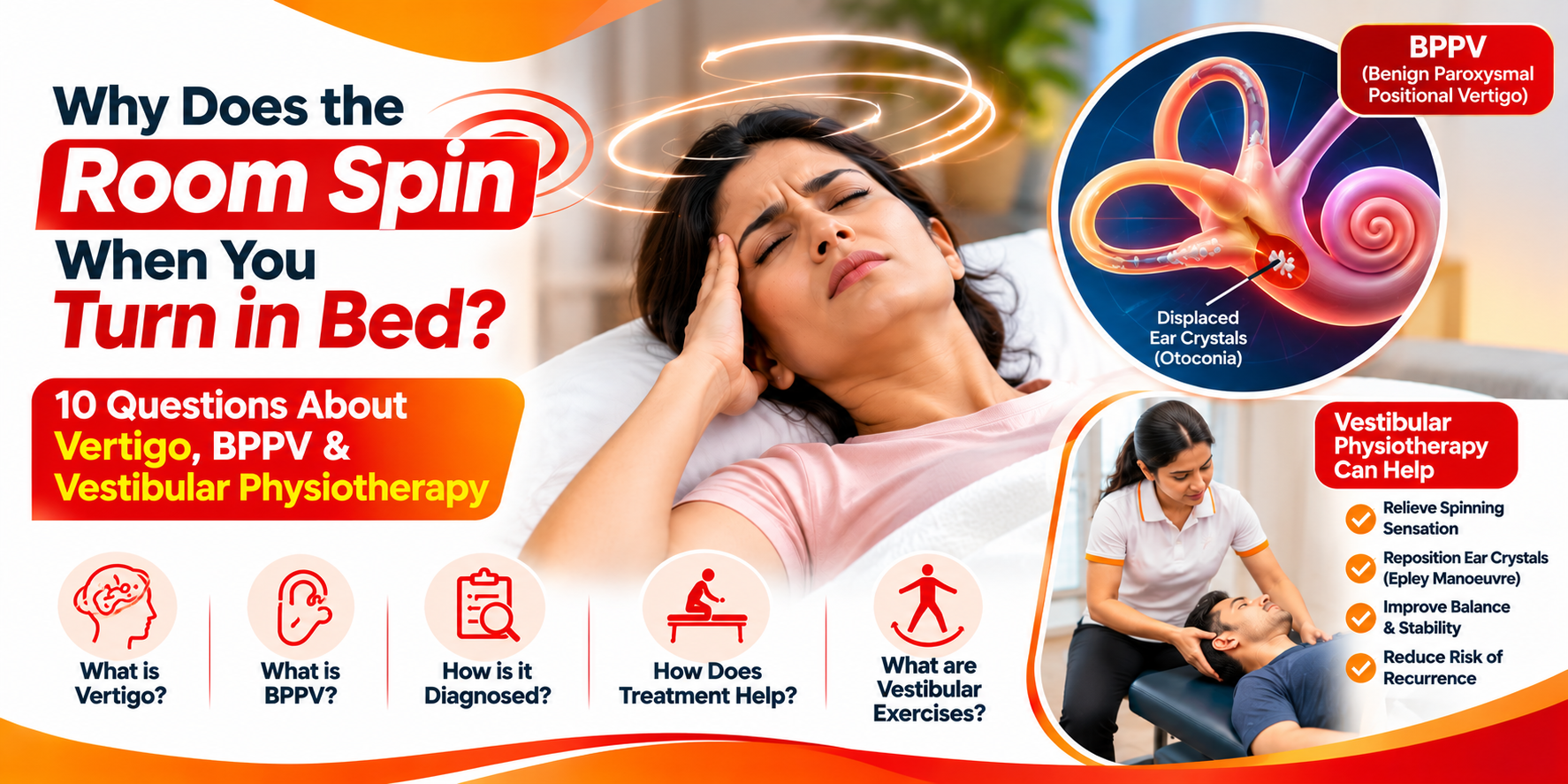
1. Complete website-ready Q&A blog
Why Does the Room Spin When I Turn in Bed?
Have you ever turned to one side while sleeping and suddenly felt that the entire room was spinning? Does your head feel dizzy when you get out of bed, look upwards, bend down or turn quickly?
You are not alone. These symptoms may be associated with vertigo, particularly a condition called Benign Paroxysmal Positional Vertigo (BPPV).
Vertigo can affect walking, balance, confidence and everyday activities. The good news is that certain causes of vertigo, including BPPV, can often be treated effectively after proper assessment.
At Rays of Hope Physiotherapy, Robotic Rehabilitation & Wellness Center, Rajkot, we believe that understanding the cause of dizziness is the first step towards choosing the right rehabilitation approach.
Here are 10 important questions about vertigo, BPPV and vestibular rehabilitation.
Q1. Why does the room spin when I turn my head or change my sleeping position?
A spinning sensation triggered by specific head movements may be caused by BPPV.
People with BPPV commonly experience vertigo when:
Turning from one side to another in bed.
Getting up from a lying position.
Looking upwards towards the ceiling.
Bending forward.
Moving the head quickly.
Episodes are often brief, lasting seconds, although the uncomfortable sensation may take longer to settle.
However, not every episode of dizziness is BPPV. Inner-ear disorders, vestibular migraine, medication effects and neurological conditions can also cause dizziness.
A proper assessment is important to identify the cause.
NHS+1
Q2. What is BPPV (Benign Paroxysmal Positional Vertigo)?
BPPV is a common inner-ear condition that causes brief episodes of spinning sensations when the head moves into certain positions.
Inside the inner ear are tiny calcium carbonate particles called otoconia. They normally help the body detect gravity and movement.
Sometimes these particles become displaced and enter one of the semicircular canals. This can send incorrect movement signals to the brain, producing a spinning sensation during particular head movements.
The condition is called:
Benign: Usually not life-threatening.
Paroxysmal: Occurs in sudden episodes.
Positional: Triggered by particular head positions.
Vertigo: A sensation that you or your surroundings are spinning.
BPPV is one of the common causes of positional vertigo, but a clinician should confirm the diagnosis.
AAO-HNS+1
Q3. What are the common symptoms of vertigo?
Vertigo may produce several symptoms, including:
A sensation that the room is spinning.
Dizziness when turning the head.
Difficulty maintaining balance.
Nausea or vomiting.
Unsteadiness while walking.
Discomfort when changing sleeping positions.
Fear of falling.
Difficulty performing daily activities.
Some patients describe the feeling as if they are standing on a moving boat.
Important distinction: Vertigo describes a spinning sensation. General dizziness, light-headedness and imbalance can have different causes and require different assessment approaches.
Q4. Is vertigo dangerous? When should I worry?
Many cases of positional vertigo are treatable, but sudden dizziness should not automatically be assumed to be an inner-ear problem.
Emergency warning signs
Seek emergency medical care immediately if sudden dizziness or vertigo occurs with:
Facial drooping.
Weakness or numbness of an arm or leg.
Difficulty speaking or understanding speech.
Double vision or sudden loss of vision.
Severe difficulty walking or sudden loss of coordination.
A sudden, unusually severe headache.
Loss of consciousness.
These symptoms can indicate a serious neurological emergency, including stroke.
New hearing loss, severe persistent vomiting, severe headache or fever also require prompt medical assessment.
NHS+1
Q5. How is BPPV diagnosed?
A healthcare professional trained in vestibular assessment may use specific clinical tests to identify the affected inner-ear canal.
Common assessments include:
1. Dix-Hallpike test
The clinician moves the patient's head and body into specific positions while observing symptoms and eye movements. It is commonly used to assess posterior canal BPPV.
2. Supine Roll Test
This test may be used to assess horizontal canal BPPV when indicated.
3. Balance and gait assessment
The clinician evaluates standing balance, walking ability, movement control and fall risk.
4. Medical history and neurological screening
The clinician reviews the pattern of dizziness, associated symptoms, medical history and possible alternative causes.
Not every patient with typical BPPV requires brain imaging. Additional investigations may be needed when symptoms or examination findings suggest another diagnosis.
AAO-HNS+2
Q6. Can physiotherapy treat vertigo?
Yes. Physiotherapy can play an important role in managing selected vestibular conditions.
The treatment depends on the underlying diagnosis.
For BPPV, a trained clinician may use a canalith repositioning manoeuvre, such as the Epley manoeuvre, to guide displaced particles out of the affected semicircular canal.
For other vestibular conditions, a programme may include:
Gaze stabilisation exercises.
Balance retraining.
Gait training.
Habituation exercises when appropriate.
Postural control training.
Functional mobility exercises.
Vestibular rehabilitation is a recognised treatment approach for selected causes of persistent dizziness and balance dysfunction.
AAO-HNS+1
Q7. What is the Epley manoeuvre, and how does it help?
The Epley manoeuvre is a series of carefully guided head and body movements used to treat certain types of BPPV, particularly posterior canal BPPV.
Its purpose is to reposition displaced particles from the affected semicircular canal into an area where they no longer trigger abnormal movement signals.
The manoeuvre is selected according to the affected side and canal.
It is important to remember:
The correct diagnosis should be established first.
The affected side and canal must be identified.
The technique should be performed by someone appropriately trained.
Neck or spinal conditions may affect whether a particular manoeuvre is safe.
Some patients may need reassessment or repeat treatment.
Do not repeatedly perform random YouTube vertigo exercises or Epley manoeuvres without knowing which side and canal are affected. The wrong manoeuvre may be ineffective or aggravate symptoms.
Clinical guidelines recommend appropriate canalith repositioning procedures for diagnosed posterior canal BPPV.
AAO-HNS+1
Q8. What are vestibular rehabilitation exercises?
Vestibular rehabilitation is a specialised exercise-based approach that aims to improve balance, gaze stability, movement tolerance and functional mobility.
Depending on the diagnosis, a physiotherapist may prescribe:
| Exercise category | Rehabilitation objective |
|---|---|
| Gaze stabilisation | Improve visual stability during head movement |
| Balance training | Improve postural control |
| Gait training | Improve walking confidence and stability |
| Habituation exercises | Gradually improve tolerance to specific movement-related symptoms |
| Functional exercises | Improve everyday movement and mobility |
Not every exercise is suitable for every type of vertigo.
For example, exercises used for vestibular hypofunction may differ from the repositioning manoeuvres used for BPPV. A personalised programme is therefore important.
AAO-HNS+1
Q9. How long does it take to recover from vertigo?
Recovery depends on the underlying cause.
In many cases of BPPV, symptoms improve after appropriate repositioning treatment. Some patients require repeated treatment or follow-up assessment.
Other vestibular conditions may require a longer rehabilitation programme involving balance and gaze stabilisation exercises.
Recovery can depend on:
The underlying vestibular diagnosis.
Severity and duration of symptoms.
Whether more than one vestibular system is involved.
Associated neurological or medical conditions.
Adherence to the prescribed rehabilitation programme.
Risk of falls and other functional limitations.
There is no single recovery timeline for all patients. Persistent or recurrent symptoms should be reassessed rather than treated indefinitely with the same exercises.
AAO-HNS+2
Q10. Where can I get vertigo and vestibular physiotherapy in Rajkot?
If dizziness is affecting your walking, balance, confidence or daily activities, a proper assessment can help identify the most appropriate next step.
At Rays of Hope Physiotherapy, Robotic Rehabilitation & Wellness Center, Rajkot, our rehabilitation approach focuses on understanding the patient's condition and selecting suitable treatment according to clinical findings.
Depending on the assessment, rehabilitation may involve:
Balance and postural control training.
Vestibular rehabilitation exercises.
Gait and mobility training.
Functional movement retraining.
Appropriate repositioning manoeuvres by trained professionals.
Individualised home exercise guidance.
Our objective is to support safer movement, improved balance and better participation in daily activities.
Book an assessment at Rays of Hope
Specialty Rehabilitation Programs in Chennai | Move Physio Care & Rehab Center
University Road Branch
Near Khodiyar Dairy, Panchayat Chowk, University Road, Rajkot, Gujarat.
Neuvive | Neuro Rehab & Physiotherapy Centre in Trivandrum
Mota Mava Branch
Opp. Sunshine School, Behind Karan Arjun Party Plot, New Ring Road, Rajkot, Gujarat.
Call: +91 82001 33691
Website: www.raysofhope.co.in
Medical disclaimer: This article is for general education and does not replace medical assessment. Sudden vertigo with neurological warning signs requires emergency evaluation.