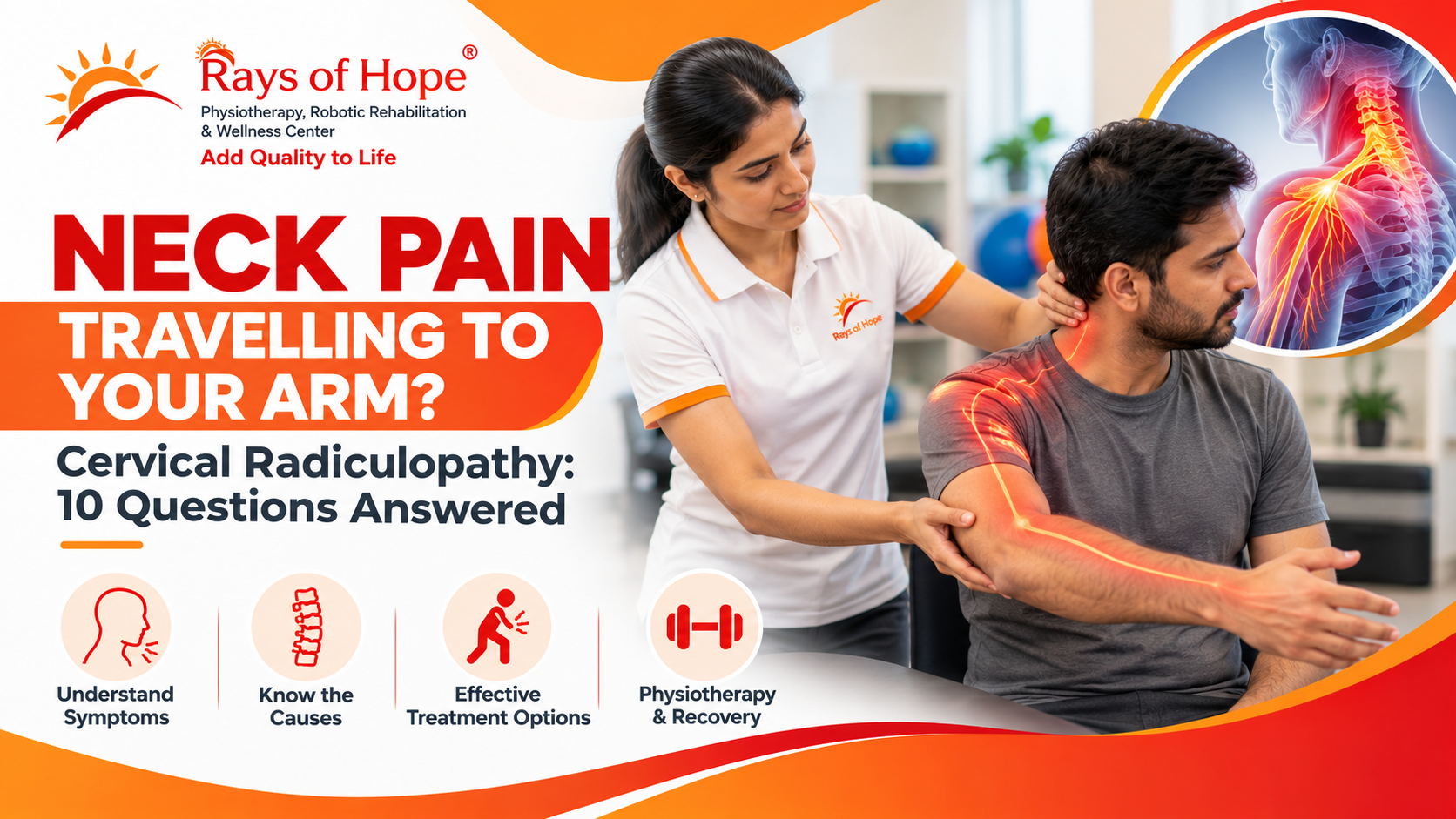
Why Does My Neck Pain Spread to My Shoulder, Arm or Fingers?
Do you experience neck pain that travels into your shoulder, arm or fingers? Do you notice tingling, numbness or weakness when turning your head or performing everyday activities?
These symptoms may be associated with cervical radiculopathy, a condition in which a nerve root in the neck becomes irritated or compressed.
Cervical radiculopathy can affect sleep, work, driving, lifting and daily activities. The appropriate treatment depends on the cause, the severity of symptoms and whether the nerve or spinal cord is affected.
If you are searching for cervical radiculopathy physiotherapy in Rajkot, this guide answers 10 important questions about symptoms, causes, diagnosis, exercises and treatment.
At Rays of Hope Physiotherapy, Robotic Rehabilitation & Wellness Center, Rajkot, patients can enquire about physiotherapy assessment and available musculoskeletal rehabilitation services.
1. What Is Cervical Radiculopathy?
Cervical radiculopathy occurs when a nerve root emerging from the cervical spine, or neck, becomes irritated or compressed.
These nerves carry signals between the spinal cord and the shoulders, arms and hands. When a nerve root is affected, symptoms may extend beyond the neck into the upper limb.
Possible symptoms include:
Neck pain spreading to the shoulder or arm.
Tingling or pins and needles in the hand or fingers.
Numbness in part of the arm or hand.
Weakness in certain arm or hand movements.
Pain that changes with neck position.
Reduced ability to perform gripping or lifting tasks.
Not everyone experiences all these symptoms. Some people have prominent arm pain with relatively little neck pain.
Cervical radiculopathy is different from uncomplicated neck muscle pain, and an assessment is important to identify the likely cause.
2. What Causes Neck Pain That Travels Down the Arm?
Several conditions can irritate a nerve root in the neck.
Cervical disc herniation: A disc may bulge or herniate and irritate a nearby nerve root.
Age-related spinal changes: Changes in the discs, joints or surrounding structures can narrow the space available for a nerve.
Cervical foraminal narrowing: The opening through which a nerve exits the spine may become narrowed.
Injury: Certain neck injuries can affect spinal structures or nerve roots and require appropriate assessment.
Other neurological conditions: Some disorders affecting peripheral nerves or the spinal cord can produce similar symptoms and must be considered when appropriate.
The symptoms alone cannot reliably establish the cause. A clinical examination helps determine whether further medical investigation is needed.
3. How Can I Tell Whether My Arm Pain Is Coming From My Neck?
Neck-related nerve pain may be suspected when pain, tingling, numbness or weakness extends from the neck or shoulder into the arm or hand.
A healthcare professional may assess:
Neck movement and symptom response.
Shoulder and upper-limb movement.
Muscle strength.
Sensation in the arm and hand.
Reflexes when indicated.
Hand coordination and functional ability.
Other possible causes, including shoulder conditions and peripheral nerve problems.
No single symptom or examination test proves the diagnosis in every patient.
Seek assessment if symptoms persist, interfere with normal activities or include numbness or weakness. New or progressive neurological symptoms need prompt medical review.
4. Can Physiotherapy Help Cervical Radiculopathy?
Physiotherapy may help suitable patients manage symptoms and gradually improve movement and function.
Depending on the assessment, a programme may include:
Education about symptoms and activity management.
Gentle neck and shoulder mobility exercises.
Progressive strengthening of the neck, shoulder and upper-limb muscles.
Postural and movement-control exercises where relevant.
Gradual return to work and daily activities.
Selected manual therapy or nerve-mobility techniques when appropriate.
Monitoring of neurological symptoms and functional progress.
Treatment should be individualised. A technique that helps one patient may not be appropriate for another, especially when significant neurological deficits are present.
Physiotherapy does not guarantee that a compressed nerve will be fully decompressed or that every symptom will resolve. Progressive weakness or signs of spinal cord involvement require medical assessment rather than continued exercise alone.
5. Which Exercises May Help Neck Pain Radiating to the Arm?
Exercise selection depends on the suspected cause, symptom severity and neurological examination.
A physiotherapist may consider:
Gentle neck movement: Controlled movement within a comfortable range may help maintain mobility when appropriate.
Shoulder blade control: Exercises targeting the shoulder and upper-back muscles may support movement and functional capacity.
Neck and upper-limb strengthening: Progressive strengthening may be introduced when it is suitable for the patient's condition.
Nerve-mobility exercises: Selected patients may benefit from carefully prescribed nerve-gliding techniques. These should not be forced or used if they worsen symptoms.
General physical activity: Maintaining suitable daily activity and avoiding prolonged periods in one position may support recovery.
There is no universal exercise sequence for cervical radiculopathy. Stop an exercise and seek advice if it causes increasing arm pain, new numbness or weakness, or worsening coordination.
Avoid forceful neck manipulation, aggressive stretching or unsupervised traction when the diagnosis and neurological status have not been assessed.
6. Do I Need an MRI for Cervical Radiculopathy?
Not everyone with neck pain or suspected cervical radiculopathy needs an MRI immediately.
A healthcare professional usually begins with a history and physical examination. Imaging may be considered when symptoms persist, are severe or disabling, neurological findings are concerning, or the result is likely to change treatment decisions.
MRI can help evaluate discs, nerve roots and the spinal cord when clinically indicated. However, scan findings must be interpreted alongside the patient's symptoms and examination.
Do not assume that every degenerative change seen on an MRI is necessarily responsible for the pain.
If you have progressive weakness, difficulty walking, loss of hand coordination or other concerning neurological symptoms, do not delay medical assessment while waiting to try physiotherapy exercises.
7. How Long Does Cervical Radiculopathy Take to Improve?
Recovery varies according to the cause, symptom severity, neurological involvement and overall health.
Many people improve with time and appropriate conservative management. Symptoms may begin to settle over several weeks, but some cases take longer and may fluctuate.
Factors that influence recovery include:
The degree of nerve irritation or compression.
Whether muscle weakness is present.
The activities that aggravate symptoms.
The person's general health and physical conditioning.
Response to treatment and activity modification.
If symptoms are not improving after several weeks, or they become more severe, seek reassessment. Do not use a fixed recovery timeline to dismiss worsening symptoms.
8. Should I Stop Working, Driving or Exercising?
Not necessarily. The right level of activity depends on your symptoms, strength, coordination and ability to perform tasks safely.
Helpful strategies may include:
Taking movement breaks instead of remaining in one position for long periods.
Adjusting work tasks that consistently aggravate symptoms.
Returning to normal activities gradually as tolerated.
Avoiding heavy lifting or forceful neck movements that worsen symptoms.
Following clinical advice about exercise and work modifications.
Do not drive if pain, weakness, numbness or restricted neck movement prevents you from controlling the vehicle safely.
If your work involves heavy lifting, machinery or tasks requiring reliable hand strength, discuss safe work modifications with your healthcare professional.
9. When Is Neck Pain With Arm Symptoms an Emergency?
Most neck and arm symptoms do not automatically indicate an emergency, but certain warning signs require prompt medical assessment.
Seek urgent medical attention if you experience:
New or progressively worsening arm or hand weakness.
Increasing clumsiness, such as repeatedly dropping objects or difficulty fastening buttons.
New difficulty walking, poor coordination or changes in balance.
Symptoms affecting both arms or multiple limbs.
New bladder or bowel dysfunction alongside neurological symptoms.
Severe neck pain following a significant injury.
These symptoms may indicate spinal cord involvement or another serious condition. Sudden weakness with facial drooping, speech difficulty or other signs of stroke requires emergency services.
Do not continue routine physiotherapy without medical review when these warning signs are present.
10. Where Can I Get Cervical Radiculopathy Physiotherapy in Rajkot?
People searching for cervical radiculopathy physiotherapy in Rajkot can contact Rays of Hope Physiotherapy, Robotic Rehabilitation & Wellness Center, to enquire about assessment and available physiotherapy services.
Depending on the clinical findings, rehabilitation may focus on:
Assessment of neck and upper-limb symptoms.
Evaluation of movement, strength and functional limitations.
Individualised mobility and strengthening exercises.
Advice on activity modification and work-related demands.
Monitoring of symptoms and functional progress.
Referral for medical assessment when neurological warning signs or other concerns are identified.
The appropriate treatment depends on the diagnosis and the patient's needs. Not every person requires imaging, traction, manual therapy or the same exercise programme.
Book a Neck and Arm Pain Physiotherapy Consultation in Rajkot
Neck pain that travels into the arm can interfere with sleep, work and everyday activities. An appropriate assessment can help clarify the likely cause and identify suitable next steps.
Rays of Hope Physiotherapy, Robotic Rehabilitation & Wellness Center
Appointment contact: +91 82001 33691
University Road Branch: Near Khodiyar Dairy, Panchayat Chowk, University Road, Rajkot, Gujarat.
Mota Mava Branch: Opp. Sunshine School, Behind Karan Arjun Party Plot, New Ring Road, Rajkot, Gujarat.
Website: https://www.raysofhope.co.in/
Rays of Hope — Add Quality to Life.
Medical disclaimer: This article is for educational purposes and does not replace an individual medical or physiotherapy assessment. New or worsening neurological symptoms require prompt medical review.